The Map We Would Build for a Sacramento Cannabis Retailer
Buying cannabis is lawful in California and can still cost a non-citizen their status. A shop that says so plainly gives itself a chance of being named when a customer searches for the answer.
Cannabis remains a federally controlled substance, and federal immigration law makes a person inadmissible for a controlled substance offence, including where they simply admit the conduct. 8 U.S.C. section 1182(a)(2)(A)(i)(II). A lawful purchase under state law, admitted at a border or on a form, is enough.
Almost no shop publishes this, and it is the single most consequential thing a buyer could be told. That is one page. There are 71 in this map, and this is all of them.
What this is
This is the complete content programme we would build for a licensed cannabis retailer in Sacramento, derived rather than estimated. Every page answers one question a buyer actually has, and names the source that answers it.
You are looking at the structure. None of these pages has been written. We show the map before the work, because the map is the part you are actually buying.
Sacramento is the example, not the limit. The same derivation runs for any state and any city. The statutory layer changes with the state and the method does not change at all.
What your shop gets from it
You become the shop the answer comes from.
Cannabis retail cannot advertise the way other retail can, and the platforms that reach buyers are mostly closed to it. That makes being the published answer worth more here than almost anywhere else, because the usual way of buying attention is not available.
Someone wants to know whether they may take an edible across a state line, what the potency cap on a single piece is, or whether their landlord may forbid it. The answer comes from whatever published source covers that question properly, and it says where it came from.
Why it compounds, and why it matters more in this market
A complete map keeps working on the day you stop paying for it. The pages hold each other up: a page on edible dosing is easier to find because the pages around it explain onset, the potency cap per piece and per package, and how to read a certificate of analysis.
And this is a buyer who comes back. Nine of these pages exist only because of that, and they are a stage of their own: why the same strain is different this time, why the thing you liked vanished from the shelf, what a loyalty programme may lawfully give you, and when the rules change between one visit and the next. No other map we have derived has that stage, because no other subject in this set is bought weekly by the same person.
We measure this on ourselves rather than asking you to believe it. Our own AI search visibility, measured publishes a frozen set of prompts, keeps the raw responses, and re-runs identically, so the claim can be checked instead of asserted.
How this works in search, in plain terms
Search engines and AI assistants do not reward more pages. They reward complete coverage of a subject.
The term for that is topical authority, and it means being the source that answers every question a subject contains, rather than the source with the most pages about it.
Completeness is measured against the subject, not against your competitors. The questions a purchase raises exist because the law and the product create them, whether or not anyone has typed them into a search box yet.
The map
This map has eight stages rather than seven, because the buyer comes back. Who may buy, finding a licensed shop, how much you may buy, what it costs, what is on the label, where you may use it, when something goes wrong, and coming back.
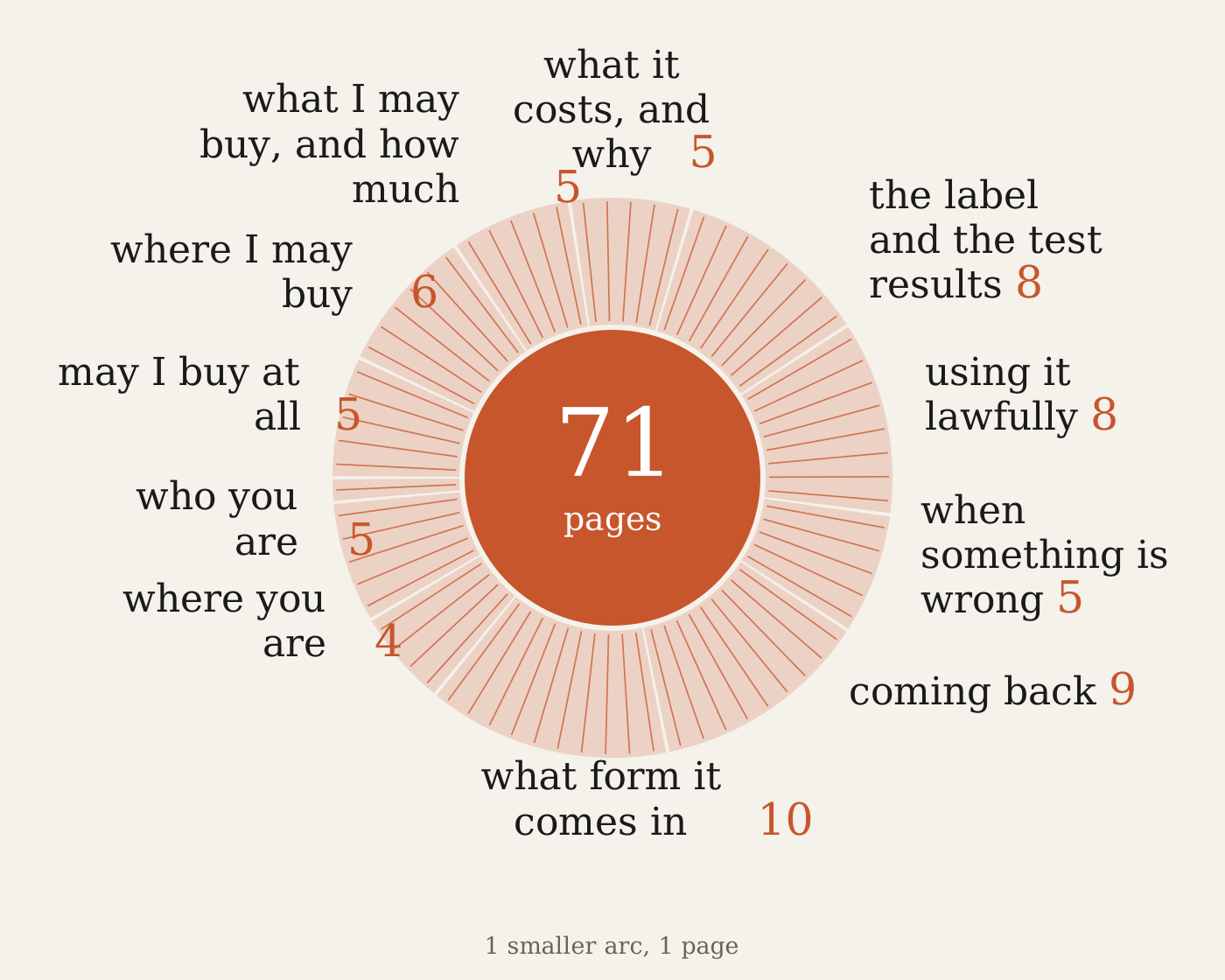
Each spoke is one page and each arc is a stage of a purchase, or a layer that cuts across all of them.
Why it is this long, and not longer
One page per question a buyer has to resolve, where a named source gives a different answer.
Not one page per product. Not one page per keyword. If the answer for one strain is the answer for another, it is one page, and it almost always is.
Fifty-one of the 71 are answered by statute or regulation, and that is unusual
This is the most heavily regulated subject in this set. Age, quantity, potency, labelling, testing, packaging, where you may consume and what a shop may give away are all written down in the Business and Professions Code, the Health and Safety Code and title 4 of the California Code of Regulations.
That is a market where the published answer can be exactly right rather than merely helpful, and where a shop that publishes it is checkable.
This map has fewer internal links than the others, and that is a property of the subject
Most cannabis questions are general to the buyer rather than specific to what they are buying. The age to buy, the tax, where you may consume and what happens in a recall are the same answer whatever is in the bag. Only eleven of the 71 pages sit on a product form at all.
So this map is a hub with a very wide rim rather than a set of long chains, and we would rather report that than manufacture connections to make it look like the others.
Every page on the map, listed
71 titles, and you can read every one of them. They are grouped the way the map is derived: by the stage of a purchase they answer, then by the question they belong to. Every branch shows its count. Collapse any of them to navigate; nothing is hidden on arrival.
Every title names the best source its question admits. That is the claim, and it is not the same as a percentage of statute. The age to buy adult-use cannabis, and the ID they must check is a question California law answers, in Bus. & Prof. Code 26140, and anything softer would be a failure. Taking too much, and what to actually do is a question no statute answers, and California Poison Control System is the right source for it rather than a weaker one.
- 51 are answered by California statute, regulation or a published decision.
- 5 by a named professional body or agency, free to read and checkable in a minute.
- 0 sit behind a paywall, and the page names who owns them rather than going quiet.
- 15 have no named source, and say so.
56 of the 71 name a source, and 2 of them carry a weaker source than its question deserves. That second number is the one that matters: a question with a statutory answer that we have answered from something softer is unfinished work. A question with no statutory answer, answered from the body that actually studies it, is finished.
These branch counts include the shared questions as well as the claim-specific ones, so they run higher than the figures above, which count only what a kind of claim adds. Both are correct and they are counting different things.
Stage 1, may I buy at all 5
- The age to buy adult-use cannabis, and the ID they must check (Bus. & Prof. Code 26140)
- Medical against adult-use, and what a recommendation still gets you (Health & Saf. Code 11362.7 et seq.)
- The medical card, what it costs and what it saves (Health & Saf. Code 11362.71; Rev. & Tax Code 34011)
- Buying for someone else, and what you may lawfully pass on (Bus. & Prof. Code 26140(a)(4); Health & Saf. Code 11362.1, 11361)
- Visiting from another state, and whether you may buy here (Bus. & Prof. Code 26140)
Stage 2, where I may buy 6
- Checking a shop is actually licensed (Dept. of Cannabis Control licence search)
- How to tell a licensed shop from one that is not (Bus. & Prof. Code 26038)
- Delivery, and what the driver must carry (4 C.C.R. 15415)
- Why some cities have no shops at all (Bus. & Prof. Code 26200)
- Buying on tribal land, and why the rules differ
- Ordering online, and who actually fulfils it (4 C.C.R. 15415)
Stage 3, what I may buy, and how much 5
- How much you may buy in a day (4 C.C.R. 15409)
- How much you may carry (Health & Saf. Code 11362.1)
- The potency cap on an edible, per piece and per package (Bus. & Prof. Code 26130)
- Concentrate limits, and how they are counted (Health & Saf. Code 11362.1)
- Growing your own, and the six-plant rule (Health & Saf. Code 11362.2)
concentrate also runs at what form it comes in.
edible also runs at what form it comes in.
Stage 4, what it costs, and why 5
- The state excise tax, and what it is charged on (Rev. & Tax Code 34011)
- Local cannabis taxes, and why the same jar costs more one town over (Bus. & Prof. Code 26200)
- Why the shelf price is not the till price (Rev. & Tax Code 34011)
- Sales tax on cannabis, and when it does not apply (Rev. & Tax Code 34011; CDTFA)
- Why the same product costs different amounts at different shops
Stage 5, the label and the test results 8
- What has to be on the label before it may be sold (Bus. & Prof. Code 26120)
- The certificate of analysis, and how to read one (4 C.C.R. 15718)
- THC and CBD percentages, and what they actually tell you
- What cannabis is tested for before it reaches a shelf (4 C.C.R. 15719)
- Pesticides, and the limits that apply (4 C.C.R. 15719)
- The universal symbol, and what its absence means (Bus. & Prof. Code 26120)
- Prop 65 warnings on cannabis, and what they mean (Health & Saf. Code 25249.6)
- Child-resistant packaging, and what it is for (Bus. & Prof. Code 26120)
Stage 6, using it lawfully 8
- Where you may not consume (Health & Saf. Code 11362.3)
- Cannabis in a car, open container and driving (Veh. Code 23222(b); 23152(f))
- Taking it across a state line, and why you may not (21 U.S.C. 841)
- Cannabis and your job, and what changed in 2024 (Gov. Code 12954)
- Renting, and whether a landlord may forbid it (Health & Saf. Code 11362.45)
- Cannabis and a firearm licence (18 U.S.C. 922(g)(3))
- Consuming on the shop’s premises, and where that is allowed (Bus. & Prof. Code 26200(g))
- Cannabis around children in the home (Health & Saf. Code 11362.45)
Stage 7, when something is wrong 5
- A recall, and how you find out about one (Dept. of Cannabis Control recalls)
- Complaining about a licensed shop (Dept. of Cannabis Control complaints)
- Being sold something unlicensed, and what you can do (Bus. & Prof. Code 26038)
- Returns, and whether a shop has to take one back
- Taking too much, and what to actually do (California Poison Control System)
Stage 8, coming back 9
- Loyalty programmes, and what a shop may lawfully give you (Bus. & Prof. Code 26153.1)
- Why there are no free samples in California (Bus. & Prof. Code 26153.1)
- Discounts and promotions, and the rules a shop advertises under (Bus. & Prof. Code 26152)
- Why the same strain is different this time (4 C.C.R. 15718)
- Why the thing you liked vanished from the shelf
- Keeping track of what actually worked for you
- Pre-ordering, delivery accounts, and what they hold about you (4 C.C.R. 15042)
- Being a returning customer rather than a first-time one
- When the rules change between one visit and the next (Dept. of Cannabis Control rulemaking)
What form it comes in 10
- Flower, and what you are judging when you look at it
- Pre-rolls, and what is actually in them
- Vape cartridges, and the hardware question
- Vape additives, and what is not permitted (4 C.C.R. 17407)
- Edibles, onset, and why people take a second one (Dept. of Cannabis Control consumer guidance)
- Edible dosing, and where to start (Dept. of Cannabis Control consumer guidance)
- Concentrates, and why potency changes the maths (Health & Saf. Code 11362.1)
- Tinctures, and how they differ from an edible
- Topicals, and why they do not get you high
- Shelf life, and how to store what you bought
concentrate also runs at what I may buy, and how much.
edible also runs at what I may buy, and how much.
Where you are 4
- Sacramento, and its local cannabis rules (City of Sacramento cannabis ordinance)
- Which nearby cities allow retail and which do not (Bus. & Prof. Code 26200)
- Local tax rates, city by city (Bus. & Prof. Code 26200)
- Consumption lounges, and where they exist (Bus. & Prof. Code 26200(g))
Who the client is 5
- Buying as a medical patient under 21 (Health & Saf. Code 11362.7)
- Cannabis and a professional licence
- Cannabis, pregnancy and breastfeeding (California Dept. of Public Health)
- Older adults, and interactions with medication (California Poison Control System)
- Cannabis and immigration status (8 U.S.C. 1182(a)(2)(A)(i)(II))
The hub 1
- The California cannabis buyer map
Researched, and projected
71 titles are enumerated above, every one of them derived and taken to a source. The finished programme would land higher, and we are not going to tell you by how much.
The multiplier for this map is UNMEASURED. No page beneath this map has been researched yet. The multiplier is produced by a different act from deriving the map: it comes from reading a source for one question and noticing a question it does not answer, which cannot happen before the page beneath it is written. So this map has no outer layer, and that is a statement about the work done rather than about the subject.
We have a measured multiplier for one map and it is not this one. The personal injury map projects at 0.30 further questions per question researched, from 9 found while researching 30. That number belongs to that map. Quoting it here would be borrowing a measurement rather than making one, so this page states 71 derived and no projection.
Why this is a map and not a list
71 pages, and 7 links between them. The links are derived from the data rather than drawn by hand: a page declares what it is about, and two pages about the same thing at different points in the course are connected because they are, not because someone thought they looked related.
Take one page: The potency cap on an edible, per piece and per package. It connects to 2 others, and the links are not a guess: 2 are the same subject at another point in the course, all of them edible. Where each one sits is in brackets.
- Edibles, onset, and why people take a second one (what form it comes in)
- Edible dosing, and where to start (what form it comes in)
That is what the map buys you that a keyword list does not. Each of those pages makes the others easier to find, and a reader who arrives at any one of them has somewhere to go next that actually answers their next question.
The links run along one axis: the product form. Here is how far each one reaches.
| what it is about | pages | where it runs |
|---|---|---|
| edible | 3 | what I may buy, and how much; what form it comes in |
| concentrate | 2 | what I may buy, and how much; what form it comes in |
| vape | 2 | what form it comes in |
| flower | 1 | what form it comes in |
| pre-roll | 1 | what form it comes in |
| tincture | 1 | what form it comes in |
| topical | 1 | what form it comes in |
60 of the 71 sit on no subject at all, and that is correct rather than missing: they answer the same way whatever you are buying, so a link from one of them to another would be a link a reader would not follow.
Where this stands today
This is a demonstration map. It was derived to show how the method works, and there is no client engagement behind it. No shop commissioned it, nobody is paying for it, and none of its pages has been written, because writing them is not what it is for.
Every one of its 71 questions has been taken to a source, or recorded as having none. Two are recorded as having none and are named on the list rather than quietly dropped.
A client’s map is derived the same way and then built. This one stops at the map on purpose.
The method, briefly
The stages come from what a buyer must resolve, in order, plus one for coming back. Each stage takes one page per question where a named source gives a different answer, and products that share an answer share a page. Every source is checked at its own address rather than assumed. Our method covers how we work in general.
If you want your own map derived, for the market your shop actually serves, book a discovery call.