Best SEO Companies: How to Build a Shortlist and Check It
Every source that would hand you a ready-made shortlist of the best SEO companies is selling placement on it, so a shortlist of firms you might trust to get you named in local searches has to be built rather than adopted, and then checked against evidence you read yourself. Those are the two halves of the job and they run in that order.
We are an SEO agency, so we are one of the businesses a list like that would rank. That is the reason this page names vendor types and publishes no ranking of named agencies, including ours. The pages that do rank for this query frequently sell placement on the lists they publish, and they sell it to agencies like us.
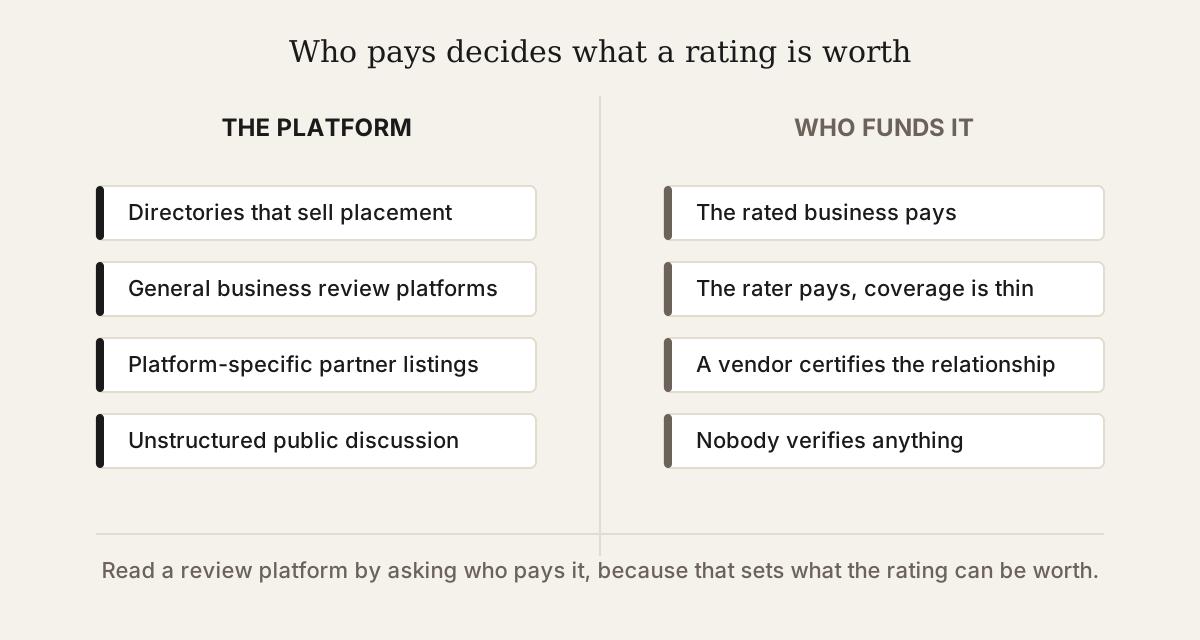
Agency reviews live on four kinds of platform with different incentives, and the incentive decides what the rating is worth. A review on a platform that also sells placement to the businesses it rates is a different instrument from a review on one that does not, and the two are usually presented to buyers as the same thing.
How a shortlist actually gets built
A shortlist comes from four sources, and placement on every one of them can be bought: directories, ranking listicles, search results and referrals. They differ in how placement is paid for, not in whether it can be, which is why adopting somebody else’s list means inheriting whoever paid for it.
Directories sell tiers, sponsored slots and lead packages to the businesses they list. Ranking listicles are published by companies that mostly sell marketing services themselves, so the list sits inside a commercial relationship with the category it ranks. Search results are earned rather than bought, but they reward whoever is best at the thing being sold here, which is not the same as whoever does the best client work. Referrals carry no placement fee and carry something else instead, which is that the person referring has a relationship with one side and usually only one comparison point.
What to do with that. Take candidates from more than one source so no single incentive shapes the whole set, cap the list at four or five, and treat every name on it as unproven until you have checked it yourself. The second half of this page is how to run that check.
The bound on what we looked at. We recorded the top ten organic results for best seo companies on 2026-08-12: clutch.co, seranking.com, agencies.semrush.com, goodfirms.co, firstpagesage.com, ignitevisibility.com, expertmarket.com, thriveagency.com and seoprofy.com. That is a record of which domains rank and nothing more. We ran no extraction against those pages, so we make no claim here about what any of them contains, and this observation says nothing about the wider web.
The vendor types, and which one fits your situation
There are five vendor types, and knowing which one fits your situation is what lets you assemble candidates without a ranking. The type decides who does the work, what it costs and what happens when the work is harder than expected.
| Vendor type | What you are buying | Fits when | What to check first |
|---|---|---|---|
| Freelancer | One practitioner’s time, directly | The work is one discipline and you can direct it | Capacity, and what happens if they are ill or take a larger client |
| Boutique | A small team, usually narrow by service | One channel decides the outcome and you want depth | Whether the person pitching is the person delivering |
| Full service | Several channels coordinated by one team | Coordination across channels is the deliverable | Which services are in house and which are placed |
| In-category specialist | Accumulated pattern in your industry | Your category has an established playbook | Named clients in category, and whether a direct competitor is one |
| Marketplace or platform | Matching, plus a managed layer | You want vetting done for you and accept the fee | Who pays the platform, and what the vetting actually tested |
None of these is better than the others. They fail differently, which is the useful part: a freelancer fails on capacity, a full service shop fails on depth, a specialist fails on originality, and a marketplace fails on whatever its vetting did not cover. Pick the failure you can live with.
What AI assistants point buyers toward
Asked how to choose a marketing agency, assistants raise reviews and third-party standing unprompted more often than almost anything else, and they name specific destinations. Across 48 responses to 16 questions about choosing an agency, put to Gemini 2.5 Flash, Perplexity Sonar and Claude Sonnet 4.6 on 30 and 31 July 2026, reviews and references were raised 34 times across all three engines, with Clutch, G2, UpCity, Yelp and Google Business Profile named as places to check.
We measure the category we sell into, so that reading is ours and comes from an interested party. The raw responses are retained so the count can be checked rather than taken on trust.
The practical consequence is that these platforms are where a buyer is being sent, which makes understanding their incentives more useful than debating whether they should be.
The four kinds, and what changes between them
Directories that sell placement. The platform earns revenue from the businesses it lists, through sponsorship, featured positions or paid profiles. The reviews themselves may be genuine and verified; what is affected is the ordering and the prominence, which is what most buyers actually read.
General business review platforms. Revenue comes from the rated business only indirectly. Coverage of agencies tends to be thin, because a marketing agency has few customers relative to a restaurant and each one is a large account.
Platform-specific partner listings. A vendor’s own directory of certified partners. Certification is real and verifiable, and it measures a relationship with the platform rather than a result for a client.
Unstructured public discussion. Forums and professional networks. No verification at all, and occasionally the only place a specific complaint appears in full.
None of the four is worthless and none is sufficient. The error is treating a high rating on any single one as an answer.
How to read a review page in five minutes
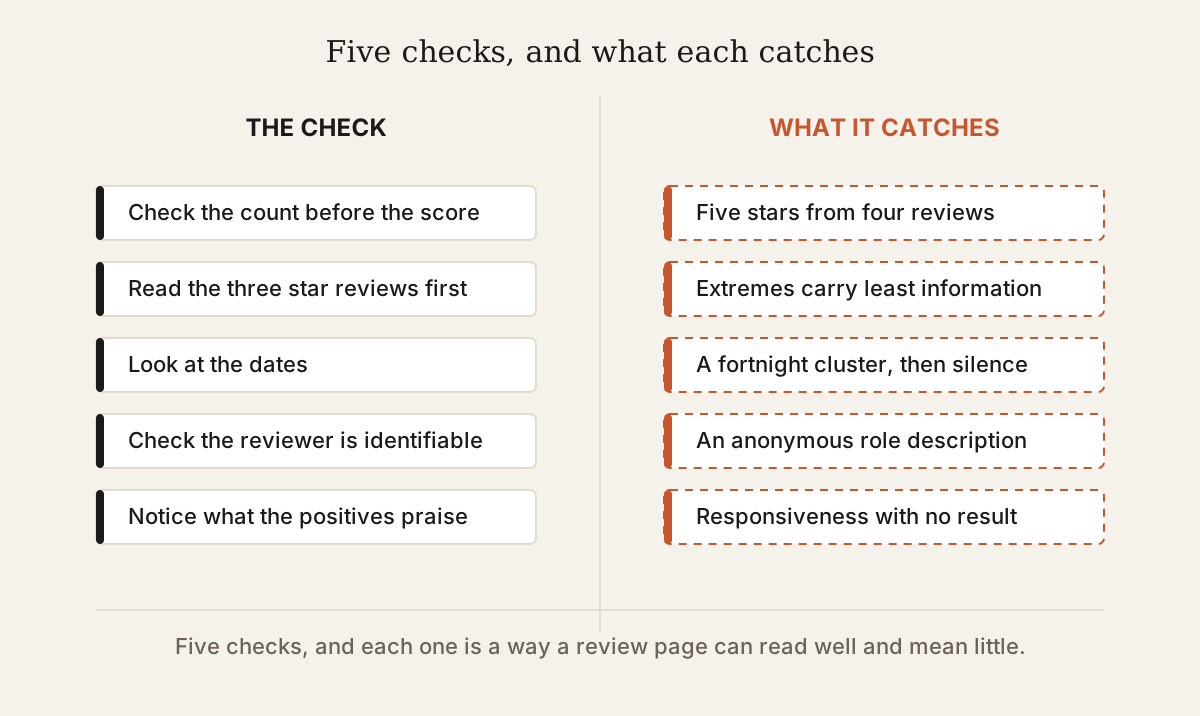
Check the count before the score. A five star average from four reviews carries almost no information. Twenty reviews at 4.6 is a much stronger signal than four at 5.0.
Read the three star reviews first. Extremes on both ends are the least informative. The middle is where specifics live.
Look at the dates. A cluster of reviews inside one fortnight, followed by silence, usually indicates a campaign rather than a pattern.
Check whether the reviewer is identifiable. A named person at a named company can, in principle, be contacted. An anonymous role description cannot.
Notice what the positive reviews praise. Reviews that praise responsiveness and communication without mentioning a result are describing an account manager rather than an outcome.
Why reviews cannot settle it on their own
A review measures the client’s experience of being a client, which correlates loosely with whether the work produced anything. A responsive, pleasant agency that delivered nothing measurable can accumulate genuinely positive reviews, because the reviewers are describing what they experienced and what they experienced was pleasant.
The sharpest version of this is a category where the satisfied client often cannot say what happened at all: law firm reviews run into confidentiality before they run into anything else, so the review that would carry the most information is the one least likely to be written.
This is why reviews sit alongside references rather than replacing them. A review is public, permanent and written for an audience. A reference is a conversation with one person who can be asked a follow-up question, and the follow-up is where the information is.
Our position
We hold no reviews on any agency directory, because we have not solicited them and would rather say that plainly than explain an absence. What we publish instead is our own measured position in AI answers, including the unflattering reading, on the grounds that a number we did not choose is worth more than a rating we collected.
That is a defensible choice and also a convenient one for a young company, and a buyer is entitled to weigh it accordingly.
The same applies twice over on this page, and it is worth saying plainly. An argument that reviews are weak evidence happens to suit an agency with few reviews, which is us. An argument that published rankings are bought happens to suit an agency that does not appear on them, which is also us. Both arguments can be true and self-serving at the same time. We have set out the reasoning and the bounds so a buyer can check it rather than take our word for it. Reviews are one of three evidence checks and the most easily gamed of them, which is why they carry the least weight on their own in the sequence a buyer can run before signing.
SEO Is My Love Language was founded by Jose Villalobos, who has spent his career on a single discipline: getting businesses found, cited, and recommended by AI search. He has been a member of Koray Tuğberk Gübür’s Holistic SEO Community since 2022, is a graduate of the Topical Authority Course, holds the Google AI Professional Certificate, and is a member of Kyle Roof’s IMG. That combination, topical authority strategy paired with rigorous on-page execution, is what our team brings to every business we work with.
Frequently asked questions
Where should I check reviews for a marketing agency?
Across four kinds of platform rather than one: directories that sell placement to the agencies they list, general business review platforms, vendor partner directories, and unstructured public discussion. Each has a different incentive and none is sufficient alone.
Are agency directory reviews reliable?
The individual reviews are often genuine and verified. What is affected on a directory that sells placement is the ordering and prominence, which is what most buyers actually read, so treat the ranking as advertising and the review text as evidence.
How many reviews should an agency have?
Enough that the average means something. A five star average from four reviews carries almost no information, while twenty reviews averaging 4.6 is a considerably stronger signal. Check the count and the distribution before the headline score.
What should I look for in the review text?
Specifics about outcomes rather than praise for responsiveness. Reviews that describe communication and availability without mentioning a result are describing an account manager. Read the three star reviews first, because the extremes on both ends carry the least information.
Are reviews or references more useful?
References, because a reference is a conversation in which you can ask a follow-up question and a review is written once for a general audience. Reviews measure the experience of being a client, which correlates only loosely with whether the work produced a result.
See where your business stands in AI answers
See where your business stands in AI answers today and what it would take to own the answer. Book a strategy call and we will show you.