Does It Matter If an Agency Only Does SEO
An agency that does one discipline and an agency that does everything are not better and worse versions of the same thing, and neither shape by itself settles whether your business is named when a customer goes looking. They are different arrangements of who carries the coordination, and the right answer depends on whether the buyer wants to carry it themselves.
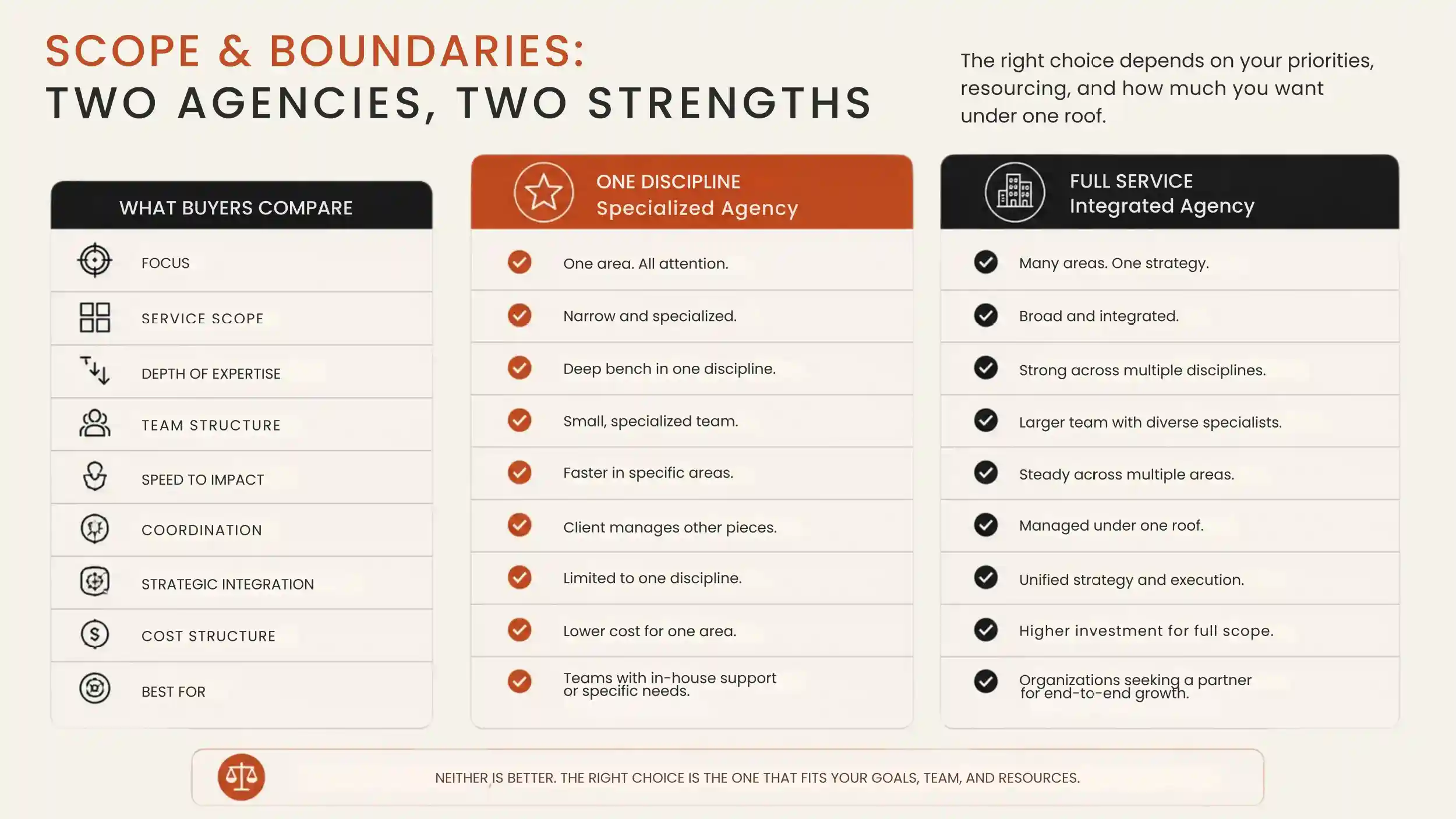
What a scope boundary actually is
A scope boundary is the line around what an agency does at all. One agency sells search visibility and nothing else. Another sells search, paid media, social, email and creative under one contract. That is the boundary, and it is a question about the shape of the supplier.
It is not the same question as industry specialisation, which asks whether an agency knows your trade. Those are two different axes and a business can be at any corner of them: a specialist in one discipline across many industries, a generalist inside one industry, either or neither. They get confused because both get asked as “are they specialists”, and they have different answers. Whether industry specialisation matters when hiring an agency is its own question with its own page.
A note on how firmly this is known. This page exists because the distinction surfaced when we put general agency-selection questions to AI assistants, and it surfaced three times across two engines, which is the fewest observations our method admits before it will record an attribute at all. Two of those three came from a single prompt. That is enough to say the question is real and not enough to say buyers commonly raise it, and it was not tested across enough different framings for us to claim the finding holds wherever you look. We would rather say that than imply a pattern we have not established.
What full service buys, and what it costs
What it buys is one contract, one invoice, one person to call, and nobody arguing about whose fault a bad month was. Where disciplines genuinely interact, and search and paid media genuinely do, one supplier holding both can move budget between them without a negotiation.
What it costs is depth. An agency covering six disciplines rarely has the same bench in each, and the practical question is which one is the strong one and whether it is yours. The weaker disciplines are frequently staffed by generalists or quietly subcontracted, which is not disqualifying but is worth knowing before you buy it. Who actually does the work at a marketing agency is the direct form of that question.
When one discipline is the right answer
The narrow agency is the right answer more often than the full-service pitch admits, and this page would be an argument rather than a guide if it did not say so.
When one channel is clearly where the growth is, a specialist puts its whole bench on it. There is no internal competition for its best people, because there is only one thing to be good at.
When you already have the coordination. A business with a marketing lead who can brief three suppliers is buying execution, not management, and paying a full-service premium for coordination it already has is paying twice.
When you want to be able to leave. One discipline with one supplier is a smaller thing to unpick than five. Leaving a marketing retainer is materially harder when the supplier holds every channel.
The honest cost of going narrow is that the coordination becomes yours. Somebody has to notice that the paid team and the search team are bidding on the same terms and briefing different messages, and with several specialists that somebody is you.
What to ask about the edges of the scope
The operative question is not how many disciplines an agency lists. It is what happens at the edge of what it does.
Ask what falls outside the scope and who picks it up. Ask whether work outside the contract is subcontracted, referred or declined, and ask it plainly enough to get an answer. Ask who is accountable when a problem spans two suppliers, because that is the moment the arrangement is tested.
Then get the answer written down. A scope that names its own boundaries is the single most useful document in the relationship, and what a scope of work has to name sets out what belongs in it. An agency that will not write down what it does not do has told you something.
Our position
We are a scope-narrow agency. We sell AI search visibility and we do not sell paid media, social, email or creative, so this page is written by an interested party and you should read it that way.
What we publish about our own result in the category we sell into is our own AI search visibility, measured, including the half of it that is blank. We would rather be judged on that than on a claim about our shape. Shape is one input to whether an agency can do the work, and not the decisive one. The check it belongs to, and the four that follow it, are worth running in that order.
One more disclosure, because it bears on how to read this page. The term this page is written against returns agency service pages and directories rather than advice, so an advice page has no natural slot in that result. We do not expect this page to rank on it, and measuring it that way would be measuring the wrong thing. It is declared as the term because it is what the page is about.
Frequently asked questions
Is a full-service agency better than a specialist?
Neither is better in general. Full service buys one contract, one point of contact and no coordination overhead, and it costs depth, because an agency covering six disciplines rarely has the same bench in each. A specialist buys depth in one channel and costs you the coordination, which becomes your job. The right answer depends on whether you already have someone who can coordinate suppliers.
Is scope boundary the same as industry specialisation?
No, and they are frequently confused because both get asked as “are they specialists”. Scope boundary asks how many disciplines an agency sells. Industry specialisation asks whether it knows your trade. A business can be a single-discipline agency serving every industry, or a generalist serving one, so the two questions have separate answers and want asking separately.
What should I ask an agency about the edges of its scope?
Ask what falls outside the scope and who picks it up, whether outside work is subcontracted, referred or declined, and who is accountable when a problem spans two suppliers. Then get it written into the scope of work. An agency that will not write down what it does not do has answered the question.
If I hire specialists, who coordinates them?
You do, or somebody you employ does. That is the real cost of going narrow and it is usually understated when specialists pitch. Somebody has to notice when the paid and search teams are bidding the same terms with different messages. If nobody in the business can hold that, the coordination a full-service agency provides is worth paying for.
How firmly is any of this established?
Scope boundary showed up three times across two engines in our own reading, which is the minimum our method records, and two of those three came from a single prompt. That is enough to treat the question as real. It is not enough to call it a common concern, and we have not tested it across enough framings to say the pattern holds generally.
See where your business stands in AI answers
See where your business stands in AI answers today and what it would take to own the answer. Book a strategy call and we will show you.