The Map We Would Build for a Sacramento Restoration Company
The map we would build for a Sacramento restoration company starts from a fact almost no restoration site publishes: the contract signed at two in the morning can be cancelled. Saying so in public is part of what gets a restoration company named in the searches a customer makes from a flooded house.
A contract signed in your own home, by someone who came to you, carries a three-day right to cancel in California, and the contract itself has to tell you so. Civil Code sections 1689.6 and 1689.7.
The homeowner signing it is standing in water, the damage is still spreading, and a stranger with a clipboard has just said he can start now. Almost nobody in that position knows they have three days. Every restoration company does.
That is one page. There are 79 in this map, and this is all of them.
What this is
This is the complete content programme we would build for a restoration company in Sacramento, derived rather than estimated. Every page answers one question a homeowner actually has during a loss, and names the source that answers it.
You are looking at the structure. None of these pages has been written. We show the map before the work, because the map is the part you are actually buying.
Sacramento is the example, not the limit. The same derivation runs for any state and any city. The statutory layer changes with the state and the method does not change at all.
What your company gets from it
You become the company the answer comes from.
A pipe has burst at two in the morning. Before anyone compares reviews, before anyone reads an advertisement, they ask for the answer they need right now. Do I call my insurer or a contractor first. Am I allowed to live here while it dries. What is this direction to pay I just signed.
The answer comes from whatever published source covers that question properly, and it says where it came from. A company that has answered the question is the company that gets named.
That is a job that reached you before it reached anyone else, at the point where the homeowner still has a decision to make rather than three vans already in the street.
Why it compounds
An advertisement works while the budget runs and stops the day it stops. A complete map does the opposite, for a reason you can check rather than take on faith.
The pages hold each other up. A page on why the drywall is cut two feet up is easier to find because the pages around it explain what the moisture readings mean, why the fans run for four days, and whether you can live in the house while they do. Each page you add makes the ones already published easier to reach.
And completeness is what earns the standing in the first place. The seventy-ninth page is worth more than the seventh, because it is the one that finishes the coverage.
We measure this on ourselves rather than asking you to believe it. Our own AI search visibility, measured publishes a frozen set of prompts, keeps the raw responses, and re-runs identically, so the claim can be checked instead of asserted.
How this works in search, in plain terms
Search engines and AI assistants do not reward more pages. They reward complete coverage of a subject.
The term for that is topical authority, and it means being the source that answers every question a subject contains, rather than the source with the most pages about it.
Completeness is measured against the subject, not against your competitors. If nobody in Sacramento has answered a question, publishing nothing about it is not keeping up, it is a gap sitting in plain sight. The questions a loss raises exist because the loss creates them, whether or not anyone has typed them into a search box yet.
The map
Every loss travels the same seven stages. There is the emergency and who you call, what you sign in the first hour, who is actually doing the work, what the insurer owes and how long it has, what is removed and dried, the rebuild and who pays the gap, and what has to be disclosed afterwards.
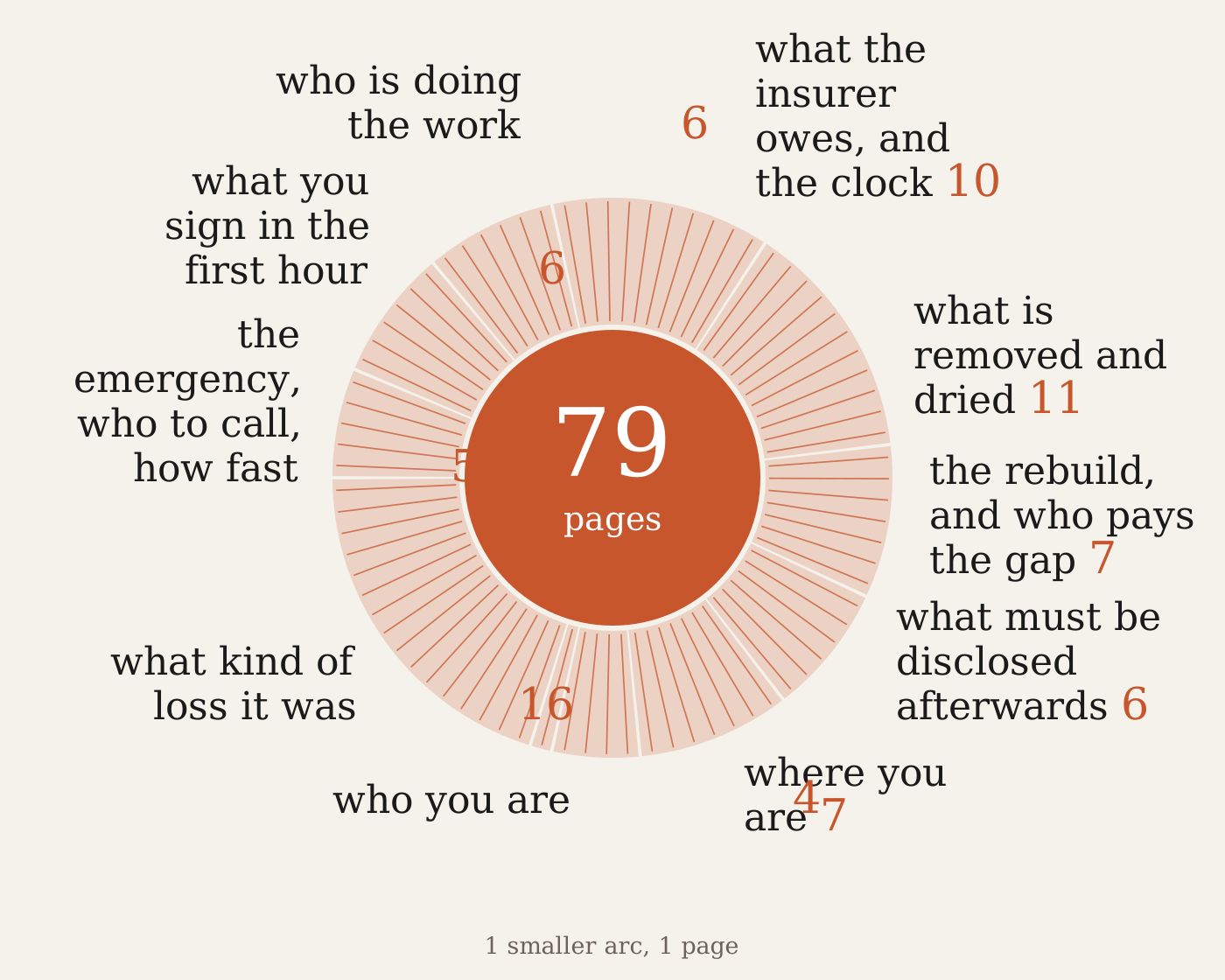
Each spoke is one page and each arc is a stage of a loss, or a layer that cuts across all of them. The width of an arc is how much of the work sits there.
The largest arc is not a stage at all. It is what kind of loss it was, and that is the finding below.
Why it is this long, and not longer
One page per question a homeowner has to resolve, where a named source gives a different answer.
Not one page per service. Not one page per keyword. If the answer for a burst pipe is the answer for an overflowing bath, it is one page.
The kind of loss is the axis, and it is the biggest thing in this map
Clean water, grey water and a sewage backup are not three names for one job. What is saved differs, what is thrown out differs, and whether you can stay in the house differs. Soot from a kitchen fire does not clean like soot from a plastics fire. Flood is not covered by a homeowners policy at all and needs a separate one.
That is sixteen pages, and it is the largest single group on the map, larger than the whole insurance claim stage.
The clock is a source, not a slogan
Three of these pages are deadlines the insurer is held to rather than advice about being patient. Fifteen days to acknowledge a claim, forty to accept or deny it, thirty to pay once accepted. Title 10 of the California Code of Regulations, section 2695. A homeowner who knows those numbers is having a different conversation from one who does not.
Every page on the map, listed
79 titles, and you can read every one of them. They are grouped the way the map is derived: by the stage of a loss they answer, then by the kind of loss that raises them. Every branch shows its count. Collapse any of them to navigate; nothing is hidden on arrival.
Every title names the best source its question admits. That is the claim, and it is not the same as a percentage of statute. Checking a restoration contractor’s licence before you let them in is a question California law answers, in Bus. & Prof. Code 7000 et seq.; CSLB licence lookup, and anything softer would be a failure. Whether you can live in the house while it dries is a question no statute answers, and U.S. Environmental Protection Agency is the right source for it rather than a weaker one.
- 37 are answered by California statute, regulation or a published decision.
- 6 by a named professional body or agency, free to read and checkable in a minute.
- 12 sit behind a paywall, and the page names who owns them rather than going quiet.
- 24 have no named source, and say so.
55 of the 79 name a source, and 2 of them carry a weaker source than its question deserves. That second number is the one that matters: a question with a statutory answer that we have answered from something softer is unfinished work. A question with no statutory answer, answered from the body that actually studies it, is finished.
These branch counts include the shared questions as well as the claim-specific ones, so they run higher than the figures above, which count only what a kind of claim adds. Both are correct and they are counting different things.
Stage 1, the emergency, who to call, how fast 5
- Who answers the phone at two in the morning, and who you are reaching
- What a response-time promise is actually worth
- Checking a restoration contractor’s licence before you let them in (Bus. & Prof. Code 7000 et seq.; CSLB licence lookup)
- Whether to call your insurer or a contractor first
- Your duty to stop the damage getting worse (Ins. Code 2071)
Stage 2, what you sign in the first hour 6
- Whether what you signed is a home improvement contract (Bus. & Prof. Code 7159)
- Your three-day right to cancel a contract signed at home (Civ. Code 1689.6, 1689.7)
- What that contract has to contain before it binds you (Bus. & Prof. Code 7159)
- The deposit a contractor may take, and the limit on it (Bus. & Prof. Code 7159.5)
- Direction to pay, and what you hand over when you sign it
- Agreeing to a scope before anyone knows what it costs
Stage 3, who is doing the work 6
- Which licence class covers water damage work (Bus. & Prof. Code 7058; CSLB classifications)
- Hiring an unlicensed restorer, and what you can recover (Bus. & Prof. Code 7031)
- The contractor’s bond, and what it actually pays out (Bus. & Prof. Code 7071.5)
- IICRC certification, what it means and who issues it (IICRC (purchase required))
- Franchise or independent, and which entity you contracted with
- Who is actually on your property, and who they work for
Stage 4, what the insurer owes, and the clock 10
- Fifteen days to acknowledge your claim (10 C.C.R. 2695.5)
- Forty days to accept or deny it (10 C.C.R. 2695.7)
- Thirty days to pay once it is accepted (10 C.C.R. 2695.7(h))
- What counts as an unfair claims practice (Ins. Code 790.03(h))
- Actual cash value, replacement cost, and the depreciation you can get back (Ins. Code 2051, 2051.5)
- Living somewhere else while you cannot live at home (Ins. Code 2051.5)
- The standard form policy, and what it must contain (Ins. Code 2071)
- Appraisal, and when to invoke it (Ins. Code 2071)
- Documenting the loss, and what happens if you do not
- Where a complaint about your insurer actually goes (California Dept. of Insurance)
Stage 5, what is removed and dried 11
- Why they cut the drywall two feet up (IICRC S500 (purchase required))
- What the moisture readings actually mean (IICRC S500 (purchase required))
- Why there are fans in your house for four days (IICRC S500 (purchase required))
- Whether you can live in the house while it dries (U.S. Environmental Protection Agency)
- Whether the hardwood will be saved or replaced (IICRC S500 (purchase required))
- What happens to your furniture and your belongings
- When you can use the room again
- Whether the smell goes, and what it means if it does not (U.S. Environmental Protection Agency)
- Whether the air is safe while the work is going on (U.S. Environmental Protection Agency)
- The equipment counts on the invoice, and what they are for
- The mould exposure limit California never adopted (Health & Saf. Code 26103)
smoke also runs at what kind of loss it was.
Stage 6, the rebuild, and who pays the gap 7
- Mitigation and rebuild are two jobs, and often two companies
- Your deductible, and whether it applies once or twice
- Matching, and what happens when they cannot match what you had (Ins. Code 2051(b))
- Supplements, and why the estimate keeps growing
- The pricing software the line items come from (Xactimate (proprietary))
- Recoverable depreciation, and the paperwork that releases it (Ins. Code 2051.5)
- Paying the contractor, and why your mortgage company is on the cheque
Stage 7, what must be disclosed afterwards 6
- Telling a buyer about past water damage (Civ. Code 1102.6)
- Mould notification, and when you must give it (Health & Saf. Code 26147)
- A landlord’s obligations after a loss (Civ. Code 1941, 1942)
- Mechanics liens after restoration work (Civ. Code 8000 et seq.)
- Complaining about a restoration contractor (Contractors State License Board)
- Whether making a claim raises your premium
Where you are 7
- When a rebuild needs a permit (Cal. Residential Code, Title 24)
- Permits for restoration work in Sacramento County (Sacramento County building permits)
- Permits in Placer County (Placer County building permits)
- Permits in Yolo County (Yolo County building permits)
- Permits in El Dorado County (El Dorado County building permits)
- Permits in San Joaquin County (San Joaquin County building permits)
- Local mould ordinances, where they exist
mould also runs at what kind of loss it was.
Who the client is 4
- Renting when your home floods (Civ. Code 1942.4, 1950.5)
- An HOA, a shared wall, and whose leak it is (Civ. Code 4775)
- Having no insurance at all, and what that costs
- When the loss was arguably your fault
The hub 1
- The California property damage loss map
What kind of loss it was 16
Clean water 1
- What is saved when the water was clean (IICRC S500 (purchase required))
Grey water 1
- Why grey water changes what can be dried and what is thrown out (IICRC S500 (purchase required))
Sewage, category three 3
- Why nothing porous survives a sewage backup (IICRC S500 (purchase required))
- Sewage backup, and whether your policy covers it at all
- Living in the house after a sewage loss (Centers for Disease Control and Prevention)
Fire and smoke 5
- Soot types, and why cleaning differs by what burned (IICRC S700 (purchase required))
- What gets cleaned and what has to be replaced (IICRC S700 (purchase required))
- Smoke damage in rooms the fire never reached
- Rebuilding to current code, and who pays for the upgrade (Ins. Code 2051.5)
- Board-up and securing the property before anyone assesses it
smoke also runs at what is removed and dried.
Mould 3
- When a water loss becomes a mould job (IICRC S520 (purchase required))
- Containment, and what a properly run mould job looks like (U.S. Environmental Protection Agency)
- Who may do mould work in California, and the licence question (Bus. & Prof. Code 7058.7)
mould also runs at where you are.
Storm and wind 3
- Why flood is not covered by your homeowners policy (44 C.F.R. 61)
- What a separate flood policy does, and where it comes from (FEMA, National Flood Insurance Program)
- Wind-driven rain, and the argument insurers make about it
Researched, and projected
79 titles are enumerated above, every one of them derived and taken to a source. The finished programme would land higher, and we are not going to tell you by how much.
The multiplier for this map is UNMEASURED. No page beneath this map has been researched yet. The multiplier is produced by a different act from deriving the map: it comes from reading a source for one question and noticing a question it does not answer, which cannot happen before the page beneath it is written. So this map has no outer layer, and that is a statement about the work done rather than about the subject.
We have a measured multiplier for one map and it is not this one. The personal injury map projects at 0.30 further questions per question researched, from 9 found while researching 30. That number belongs to that map. Quoting it here would be borrowing a measurement rather than making one, so this page states 79 derived and no projection.
Why this is a map and not a list
79 pages, and 16 links between them. The links are derived from the data rather than drawn by hand: a page declares what it is about, and two pages about the same thing at different points in the course are connected because they are, not because someone thought they looked related.
Take one page: What gets cleaned and what has to be replaced. It connects to 3 others, and the links are not a guess: 3 are the same subject at another point in the course, all of them smoke. Where each one sits is in brackets.
- Soot types, and why cleaning differs by what burned (what kind of loss it was)
- Smoke damage in rooms the fire never reached (what kind of loss it was)
- Whether the smell goes, and what it means if it does not (what is removed and dried)
That is what the map buys you that a keyword list does not. Each of those pages makes the others easier to find, and a reader who arrives at any one of them has somewhere to go next that actually answers their next question.
The links run along one axis: the loss type. Here is how far each one reaches.
| what it is about | pages | where it runs |
|---|---|---|
| water | 10 | what is removed and dried; what must be disclosed afterwards; what kind of loss it was |
| mould | 6 | what is removed and dried; what must be disclosed afterwards; where you are; what kind of loss it was |
| smoke | 4 | what is removed and dried; what kind of loss it was |
| flood | 3 | who you are; what kind of loss it was |
| sewage | 3 | what kind of loss it was |
| wind | 1 | what kind of loss it was |
53 of the 79 sit on no subject at all, and that is correct rather than missing: they answer the same way whatever you are buying, so a link from one of them to another would be a link a reader would not follow.
Where this stands today
This is a demonstration map. It was derived to show how the method works, and there is no client engagement behind it. No company commissioned it, nobody is paying for it, and none of its pages has been written, because writing them is not what it is for.
Every one of its 79 questions has been taken to a source, or recorded as having none. Two are recorded as having none and are named on the list rather than quietly dropped.
A client’s map is derived the same way and then built. This one stops at the map on purpose.
The method, briefly
The stages come from what a homeowner must resolve, in order. Each stage takes one page per question where a named source gives a different answer, and losses that share an answer share a page. Every source is checked at its own address rather than assumed. Our method covers how we work in general.
If you want your own map derived, for the losses your company actually takes, book a discovery call.