Roofing Marketing: How Roofing Companies Actually Get Found, Cited, and Called
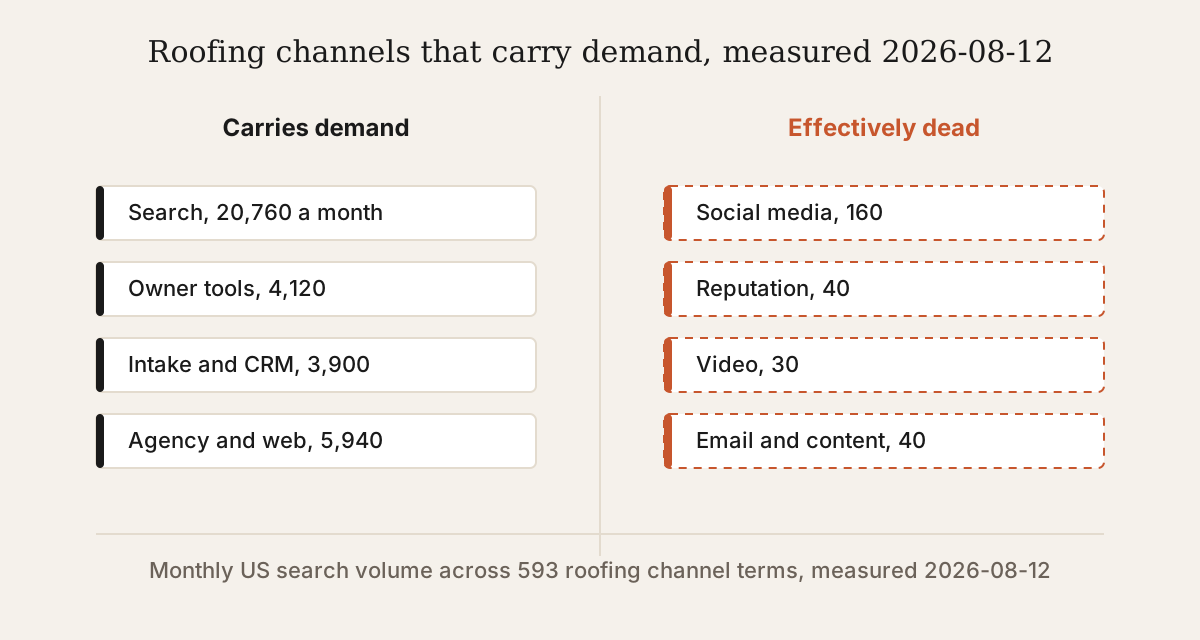
Roofing marketing is decided by four channels and quietly wasted on five others. Search, owner tools, intake and the agency and website layer carry almost all of the demand in this category, while social, reputation, video, email and content come back close to zero when the terms are actually measured. Most roofing marketing budgets are split evenly across all nine.
What roofing marketing actually is
Roofing marketing is the work of being the company that gets named when somebody with a damaged roof asks who to call, whether they ask a search engine, an AI assistant or a neighbour. That is a narrower job than it sounds, because roofing demand is not created by marketing. It is created by weather, by age, and by a real estate transaction, and it arrives whether or not anybody has been advertising.
What marketing decides is who captures demand that already exists. A roof that fails on a Tuesday produces a homeowner searching that afternoon, and the companies that appear in that moment are the ones that did the work months earlier. This is why the category rewards durability over campaigns: the search happens when it happens, and the company that is already there wins it.
It also explains why roofing has an unusually short memory. A homeowner replaces a roof once or twice in a lifetime, so there is almost no repeat purchase to amortise an acquisition against. Every job has to pay for itself, which is why the cost per acquired job is the number that matters and why channels that look cheap per click can be expensive per roof.
Which channels carry demand, measured rather than assumed
We measured 593 roofing channel terms on 2026-08-12 across the thirteen channels a local service business is usually sold, and eight of them carry real monthly search volume while five do not. That measurement is the basis for everything below, and it is worth stating plainly because most roofing marketing advice is written without one.
Search, at 20,760 a month
Search is not one channel among several here, it is the category. At 20,760 monthly searches across its variants it is five times the next largest, and it is where a homeowner with a failed roof actually goes. Within it the work splits into the map results a local business appears in, and the pages that answer the question behind the search.
The map results reward proximity, category accuracy and review volume, and they are won by keeping a Google Business Profile complete and current rather than by cleverness. The organic results reward pages that answer a specific question well enough to be quoted, which is the part that compounds and the part most roofing sites never build.
The agency and website layer, at 5,940 a month
Web design at 2,820 and marketing agency at 3,120 together form the second largest cluster, and both are searched by roofing company owners rather than by homeowners. That makes them commercially useful to understand and commercially dangerous to buy badly, because a roofing website is usually purchased once and lived with for years.
The failure mode we see most often is a site that is beautiful, slow, and silent on the questions homeowners actually ask. Insurance handling, permit responsibility, deposit terms and cleanup are the things a nervous homeowner wants answered before calling, and they are usually absent in favour of a gallery.
Owner tools, at 4,120 a month
The third largest cluster is not marketing at all. Canvassing software at 1,900, estimating software and the tools that run a roofing crew are searched more than most marketing channels in this category, which tells you where roofing owners actually spend their attention.
We name it because it changes what a marketing programme should sound like. An owner researching canvassing software is not persuaded by brand language, and content that meets them at the level of how the business actually runs will outperform content written for a generic small business audience.
Intake and CRM, at 3,900 a month
Intake is roofing’s second largest live channel and its most neglected. Roofing CRM alone carries 720 monthly searches, and call tracking, scheduling and the systems that decide whether a lead becomes an appointment sit alongside it.
This matters more in roofing than in most categories because of timing. A homeowner with an active leak calls several companies in one afternoon, and the one that answers, books and shows up first frequently wins regardless of who ranked first. Marketing that generates calls into a business that cannot answer them is an expensive way to fund a competitor.
Advertising, PPC and lead generation, at 2,310 a month combined
Paid channels are real but smaller than the category assumes. Advertising at 770, PPC at 740 and lead generation at 800 are all live, and all three buy the same thing: attention now, at a price, for as long as the budget lasts.
The honest arithmetic is that bought roofing leads are frequently sold to several companies at once, which turns the purchase into a speed contest rather than a quality contest. That can be a reasonable trade for a company with spare crew capacity and a disciplined follow up process. It is a poor trade for a company hoping to build something that keeps producing after the spend stops.
The five channels we would not build for you
Social at 160, reputation at 40, video at 30, email at 30 and content marketing at 10 are the measured monthly volumes for those channels in roofing on 2026-08-12. They are not zero, and a roofing company can absolutely use social media well, but there is no meaningful search demand for them as services.
We say this plainly because we sell marketing services and the incentive runs the other way. An agency paid per channel has every reason to sell nine channels rather than four, and a roofing company that buys a social media retainer on the strength of a general marketing argument is funding a channel this category does not search for.
Storm work, and what it does to the arithmetic
Storm and insurance work is the part of roofing marketing that behaves differently from everything else, because demand arrives in a concentrated burst that has nothing to do with the marketing calendar. A hail event produces months of work in a week, and companies that chase storms organise their whole operation around that fact.
The marketing consequence is that durable visibility and storm response are different investments and should be budgeted separately. Storm work rewards speed, canvassing and local presence at the moment of the event. Durable visibility rewards pages that answer insurance questions well enough to be found by the homeowner who is still deciding, weeks later, whether to file a claim at all.
The homeowner researching a deductible, an adjuster meeting or whether a claim will raise their premium is in the most valuable and least contested moment in this category. Almost nobody publishes for them, because it is unglamorous work that produces no gallery images.
Buy jobs or earn them, and the honest comparison
Bought leads produce work this month and stop producing the month you stop paying. Earned visibility produces nothing for several months and then produces work that continues without further spend. Neither is correct in the abstract, and the choice depends on whether the business needs cash now or an asset later.
What we would not do is pretend the second is free. Earned visibility costs real money for months before it returns anything, and a roofing company with a thin pipeline and payroll to meet should buy leads while it builds, not instead of building. The mistake we see is a company that buys leads for six years and owns nothing at the end of it.
The comparison that settles it is cost per acquired job over a full year, including the jobs that came from work published two years ago. Most roofing companies have never calculated the second number, which is why the first one wins arguments it should not.
How we would make your roofing business the cited answer
We would start from the four channels that carry demand and ignore the five that do not, which by itself reallocates a meaningful share of most roofing budgets. Within search we would build the pages that answer insurance, permit, deposit and cleanup questions, because those are the questions homeowners ask and the ones roofing sites reliably do not answer.
We would then make the intake layer match, because being found by a homeowner who cannot reach you is worse than not being found. And we would publish the awkward things: what a roof actually costs in your market, what you do when a claim is denied, and which jobs you decline. Those are the pages that get quoted, because they are the ones nobody else is willing to write.
We sell this service, so treat the argument as coming from an interested party and check it against the measurement rather than against our authority. The channel figures above are reproducible: 593 terms, US volumes, measured 2026-08-12.
The three layers of visibility a roofing company needs
Roofing visibility has three layers, and a company that has only one of them is exposed in a way it usually does not notice until the phone slows down. The layers are the map, the pages, and the answer, and they fail independently.
The map layer is the Google Business Profile and the local pack it feeds. It is won by proximity, correct categories, review volume and recency, and it is the layer most roofing companies already work on. Its limitation is that it only appears for searches the map is triggered on, which is a narrow band of highly commercial queries.
The page layer is the site itself, and specifically whether it answers questions rather than describing services. A page that says we handle insurance claims ranks for very little. A page that explains what happens when an adjuster undervalues a claim, what supplementing is, and who pays the difference, answers a real question and can be found by the person asking it.
The answer layer is new and is where the category is moving. When a homeowner asks an assistant who to call about a hail-damaged roof in their city, the assistant assembles an answer from pages it can read and sources it trusts. A roofing company that exists only in the map layer is invisible here, because there is nothing to quote.
The three compound. Pages that answer questions earn the citations that make the answer layer possible, and a strong profile makes the map layer convert. A company working only the map is renting position in the narrowest of the three.
What done for you actually looks like
Done for you in roofing marketing usually means somebody posts on your behalf and sends a report. What it should mean is that the four channels carrying demand are worked in the right order by people who understand that a roof is a distress purchase.
In practice the first ninety days are unglamorous. We would fix the profile, correct the categories, make the site fast, and write the four or five pages that answer the questions a homeowner asks before calling. None of that produces a chart that goes up in month one, and all of it is what the later months are built on.
The middle period is where the compounding starts, and it is where most roofing programmes are cancelled. Pages published in month two begin producing in month five, so a company that judges the programme at month three is judging it before the mechanism has had a chance to operate. We say this in advance rather than in a retention conversation.
What we will not do is claim a placement. Nobody controls what an assistant says, and any agency promising that a specific model will name your business is describing something they cannot deliver. What can be built is the corpus that makes being named possible, and what can be measured is whether it is happening.
Commercial and residential are two businesses sharing a name
A roofing company that does both commercial and residential work is running two marketing operations, and treating them as one is the most common structural mistake we see in the category. The buyers are different people, the decision length is different, and almost nothing transfers.
Residential is a distress purchase made by a homeowner, usually within days, often while dealing with an insurer, and heavily influenced by reviews and proximity. The marketing job is to be present and credible at the moment the roof fails.
Commercial is a considered purchase made by a property manager, a facilities lead or an owner, on a timeline of weeks or months, frequently through a bid process. Reviews matter less, references and insurance limits matter more, and proximity matters hardly at all if the crew can travel.
The consequence is that commercial work needs its own pages rather than a paragraph on a residential site. A property manager searching for a commercial roofing contractor who lands on a page about hail damage and homeowner insurance claims has learned that the company is not really aimed at them, whatever the navigation says.
Seasonality, and why it breaks most roofing measurement
Roofing demand is seasonal and weather-driven, which makes month-on-month marketing measurement close to useless and month-on-month panic close to inevitable. A quiet March compared to a busy February usually says something about the weather rather than about the marketing.
This matters more than it sounds, because it is the mechanism by which good roofing programmes get cancelled. A programme judged on a rolling three month view will look like it is failing at least twice a year, purely from the shape of the demand curve.
The defensible comparison is the same month against the same month a year earlier, and cost per acquired job across a full twelve months rather than within a quarter. Both require patience that a business under pressure does not always have, which is why we would rather set the expectation at the start than defend it later.
There is a second effect worth naming. Because storm events produce concentrated demand, a single hail event inside a measurement window can make an ineffective programme look excellent and its absence can make a good one look broken. Any roofing marketing report that does not say what the weather did in the period is describing an incomplete picture.
How to choose a roofing marketing partner
The check that separates a useful roofing partner from a general agency is whether they can name the channels that do not work in this category. An agency that proposes social, video, email and content alongside search has either not measured the category or is selling what is easy to sell.
Ask who does the work. In most agencies the person in the pitch is not the person writing your pages, and in roofing that gap shows up quickly because the writing requires knowing what a supplement is and why a deductible conversation is delicate. Ask for the name and get it in the contract.
Ask what happens when you leave. A roofing company that has paid for content for two years should own it, keep it, and continue to benefit from it afterwards. If the pages disappear or the profile access does not transfer, the arrangement was a rental and should have been priced as one.
Ask for the measurement before the promise. We publish our own position including the parts that do not flatter us, because a company that only shows favourable numbers is describing a marketing asset rather than a measurement.
Where to go from here
Everything above is about the roofing market. The other half of the decision, choosing who does the work, is identical in every trade and is answered once: what a low monthly fee actually buys, whether it matters that an agency only does one thing, and how long a contract should run. The guides hold the full set.
To judge the deliverable rather than the pitch, the maps we have published are complete programmes for five trades with the source named behind every page, and our method is how they are built.
Roofing shares more with two other trades on this site than with the rest. The insurance-funded half of the work runs the same way as a restoration claim, the travel economics match how far a flooring business travels and what changes past it, and the reviews arrive at the same wrong moment as flooring reviews written on the day the job looked best.
Frequently asked questions
Which marketing channel works best for roofing companies?
Search, by a wide margin. It carried 20,760 monthly searches across its variants when we measured the category on 2026-08-12, roughly five times the next largest channel, and it is where a homeowner with a failed roof actually goes.
Is social media marketing worth it for a roofing company?
As a paid service, the demand is not there. Social media terms carried 160 monthly searches in roofing on 2026-08-12 against 20,760 for search. A roofing company can use social media well for recruiting and for showing completed work, but buying it as a marketing channel is funding the wrong thing.
Should a roofing company buy leads?
Buying leads is a reasonable way to fill capacity now and a poor way to build something durable, because shared leads turn the purchase into a speed contest. The workable answer for most roofing companies is to buy while building rather than instead of building.
How long does earned roofing visibility take?
Months rather than weeks, and the first half of that period returns very little. That is why we would not recommend replacing bought leads with earned visibility in one step for a business that needs work this quarter.
What should a roofing website answer that most do not?
Insurance handling, permit responsibility, deposit terms and cleanup. Those are the questions a nervous homeowner asks before calling, and most roofing sites answer none of them in favour of a photo gallery.
Does storm chasing need different marketing?
Yes, and it should be budgeted separately. Storm response rewards speed and local presence at the moment of the event, while durable visibility rewards published answers for the homeowner still deciding whether to file a claim weeks later.
Get Found by AI Search
The roofing companies that win their markets in the next few years will be the ones the AI answer names, not the ones buying the same shared leads as everyone else in the county. That advantage is being built now by the contractors who understood the shift early. See how we would get your company found, cited and recommended by AI search, so the homeowner arrives already knowing who you are. Book a strategy call and we will show you where you stand today and what it would take to own that demand instead of renting it.