How Long Before an AI Assistant Names Your Business
How long it takes before an AI assistant starts naming your business is not something anyone can currently tell you, and a vendor who quotes a number is quoting a guess with a confident delivery. There is no published dataset measuring content published against subsequent AI citation, from us or from anyone else, so the honest answer is that the timeline is unknown and being measured rather than known and being withheld.
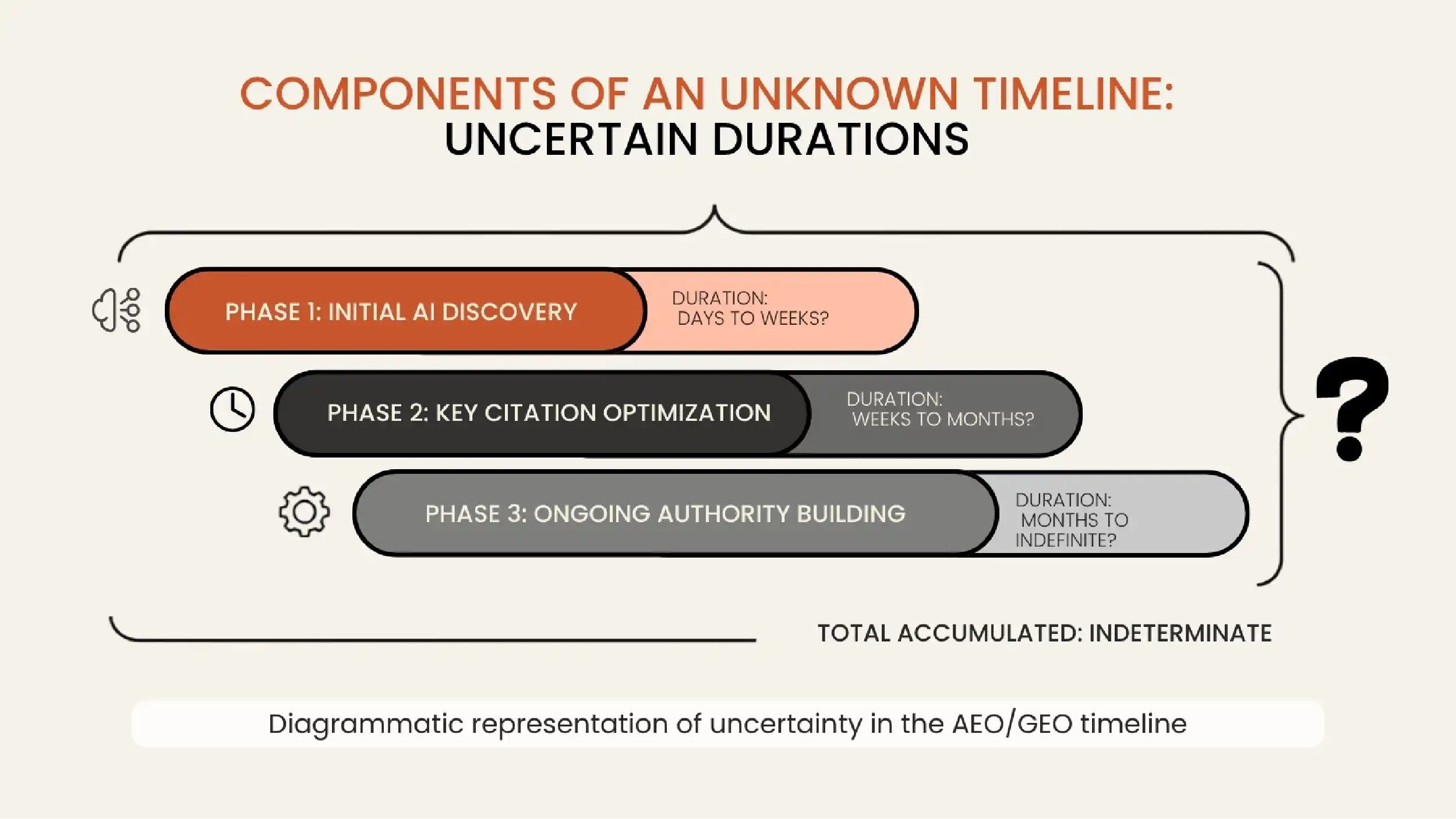
What the components suggest
The timeline has at least three parts and each has a different clock. A page must be crawled, which takes days to weeks for a new site. It must then be incorporated into whatever the assistant draws on, which varies by engine and is not published. Then a question has to be asked that the page is the best available answer to.
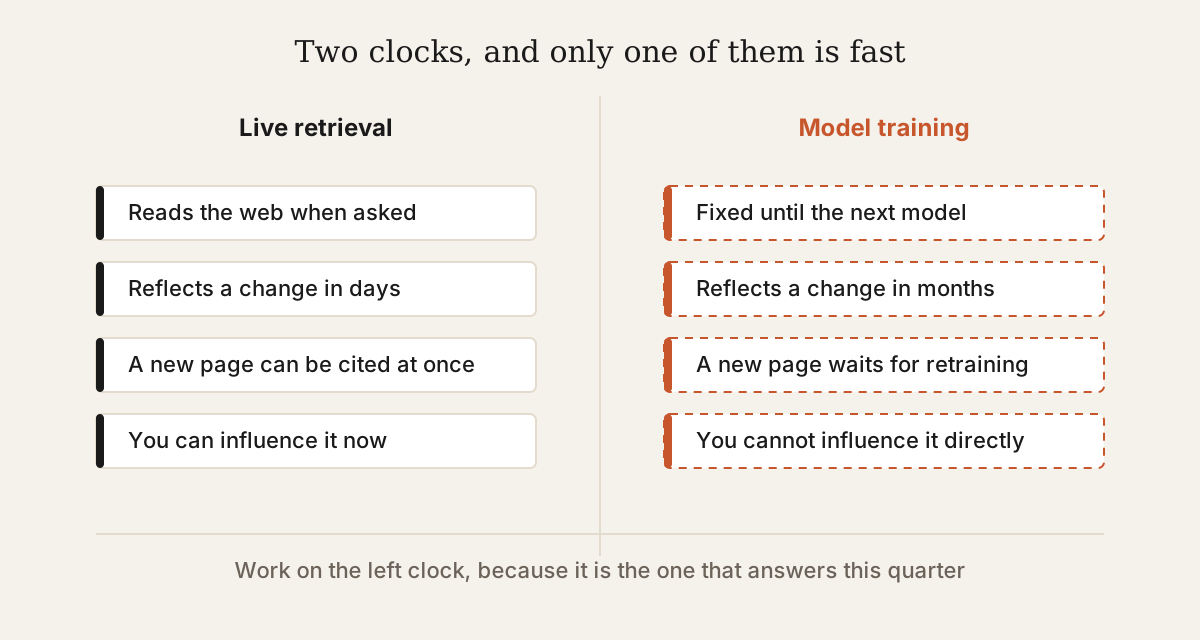
Engines with live retrieval can reflect a new page quickly, because they fetch at query time. Engines relying on a trained model cannot reflect it until that model is retrained, which is a schedule nobody outside those companies knows. So the same page can be visible to one assistant and invisible to another for reasons that have nothing to do with the page.
Why the usual six month answer is borrowed
The six to twelve month figure repeated across the industry comes from search engine optimisation, where it is grounded in years of observation. It has been carried across to AI citation because it sounds reasonable and because no better number exists.
That transfer has not been tested. Ranking and citation are different outcomes produced by different mechanisms, and a figure derived against one is not evidence about the other. We use it as a planning assumption and label it as borrowed, which is different from presenting it as a finding. A vendor who converts that borrowed figure into a commitment has crossed into what cannot honestly be guaranteed.
What we are doing about it
We took a baseline reading before publishing anything, across three assistants and a fixed set of questions, and we will re-run it identically on a schedule. That produces a first real data point on this question rather than another opinion.
The design has an obvious weakness worth stating: one company in one category is a sample of one, and a result either way will not generalise far. It is still more than currently exists publicly. Timing is one of the things a buyer can establish in advance. The two that cannot be established in advance at all are worth knowing before the question of speed comes up, because no contract term protects against either.
What to do with a vendor’s timeline
Treat a specific timeline as a statement about the vendor rather than about your business. A vendor who says three months is confident; a vendor who says the timeline is unknown and here is how we will find out is describing the actual state of the field. The questions that separate the two are about measurement rather than about dates.
The second is less comfortable to hear and it is the one that can be checked later, because it commits to a measurement rather than to a date. What that measurement can and cannot contain decides whether the commitment is worth anything.
SEO Is My Love Language was founded by Jose Villalobos, who has spent his career on a single discipline: getting businesses found, cited, and recommended by AI search. He has been a member of Koray Tuğberk Gübür’s Holistic SEO Community since 2022, is a graduate of the Topical Authority Course, holds the Google AI Professional Certificate, and is a member of Kyle Roof’s IMG. That combination, topical authority strategy paired with rigorous on-page execution, is what our team brings to every business we work with.
A timeline is only checkable against a described programme, so ours is published rather than summarised: the method we run, and the finished maps it produces, page by page with the source behind each one.
Frequently asked questions
How long does it take before an AI assistant names my business?
Nobody currently knows. There is no published dataset measuring content published against subsequent AI citation, from us or from anyone else, so a vendor quoting a specific number is quoting a guess. The timeline is unknown and being measured rather than known and withheld.
Why does the answer differ between assistants?
Because they have different clocks. Engines with live retrieval fetch at query time and can reflect a new page quickly. Engines relying on a trained model cannot reflect it until that model is retrained, on a schedule nobody outside those companies knows. The same page can be visible to one assistant and invisible to another for reasons unrelated to the page.
Where does the six to twelve month figure come from?
From search engine optimisation, where it is grounded in years of observation, and it has been carried across to AI citation because it sounds reasonable and no better number exists. Ranking and citation are different outcomes produced by different mechanisms, so a figure derived against one is not evidence about the other. We use it as a labelled planning assumption.
What is SIMLL doing to find out?
We took a baseline reading before publishing anything, across three assistants and a fixed set of questions, and we will re-run it identically on a schedule. The obvious weakness is that one company in one category is a sample of one and will not generalise far, which is still more than currently exists publicly.
What should I make of a vendor who gives me a specific timeline?
Treat it as a statement about the vendor rather than about your business. A vendor who says the timeline is unknown and describes how they will find out is describing the actual state of the field, and that answer can be checked later because it commits to a measurement rather than to a date.
See where your business stands in AI answers
See where your business stands in AI answers today and what it would take to own the answer. Book a strategy call and we will show you.