Retainer, Project or Performance: How Agencies Charge
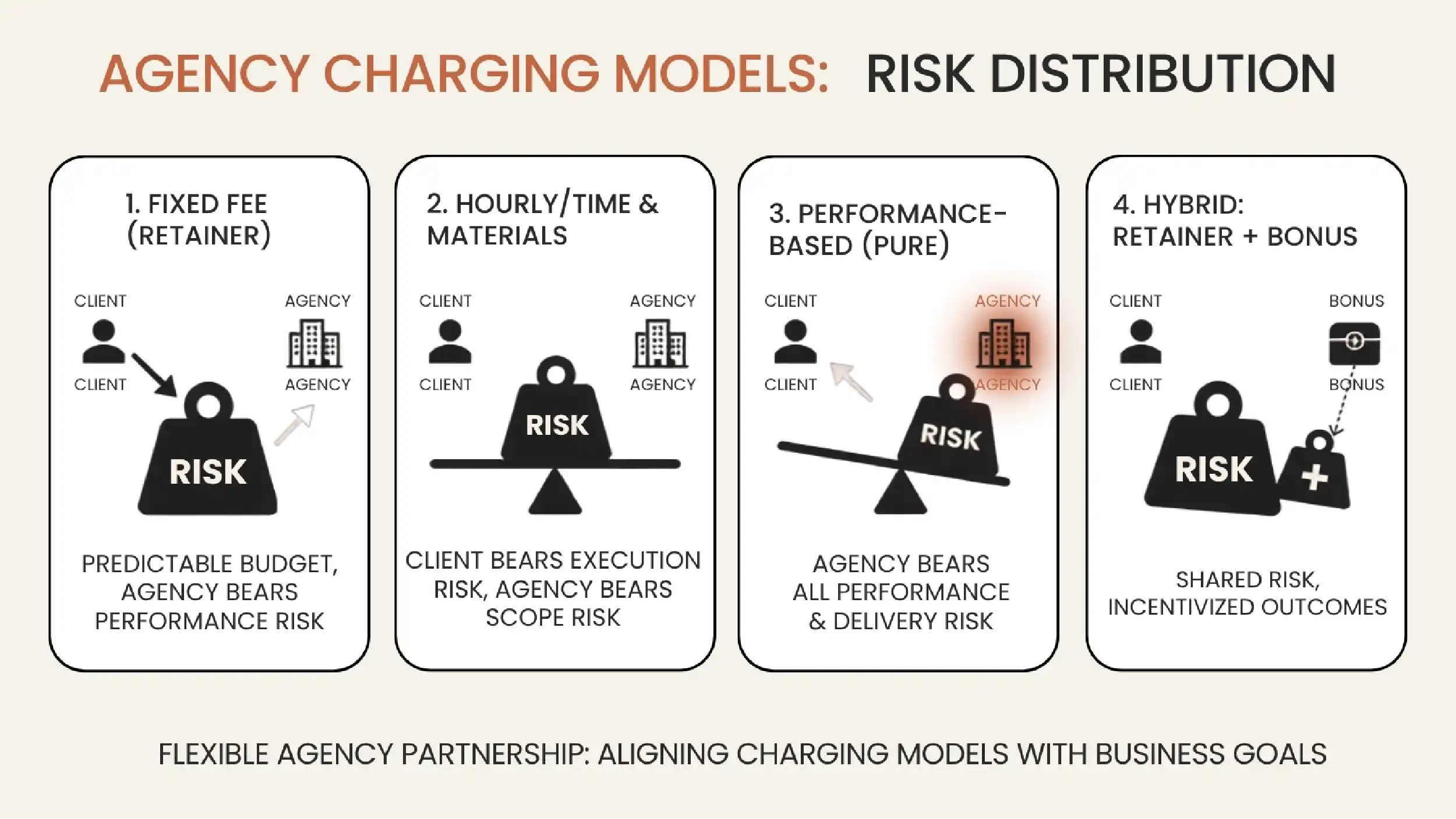
Four charging models are in common use, retainer, project, performance and hybrid, and each one puts the risk somewhere different. The risk in each case is that the work never gets your business named for a customer who searches. Choosing between them is not a negotiation about price but a decision about who carries the uncertainty, and the model that suits a buyer is usually the one that matches how predictable the work is.
Retainer, and what it is actually for
A retainer buys capacity rather than a specific outcome, which is why it suits work that is continuous and cumulative. Content programmes fit it because the value comes from sustained publication rather than from any single deliverable, and stopping and restarting wastes the compounding.
The weakness is that a retainer paid for capacity is indistinguishable, from the outside, from a retainer paid for nothing. The protection is a scope that names quantities, so capacity has a floor and the invoice has something to be checked against.
Project pricing, and where it stops working
A project price suits work with a defined end: a site rebuild, a technical audit, a migration. Both sides can see what finished looks like, and the risk of estimating it sits with the agency.
It stops working for anything continuous. Content and visibility work priced as a project ends the moment the deliverable is handed over, which is usually before the result appears, and the buyer is then asked to buy a second project to sustain the first. Where a project price is offered for continuous work, the question worth asking is what happens in month four.
Performance pricing, and the catch
Performance pricing sounds like the model that aligns everybody, and it is rarer in practice than in conversation because of one structural problem: it requires both sides to agree, in advance and in writing, on a metric neither side fully controls.
Ranking positions and AI answer placements are produced by systems neither party operates, so a performance clause written against them is a bet on a third party’s behaviour. What performance clauses more often measure instead is an intermediate the agency does control, such as pages published or leads delivered, and a lead-based clause changes the incentive toward volume of leads rather than quality of them.
Performance pricing works best where the metric is unambiguous, attributable and close to money. It works worst where the metric is a proxy, which in this category it usually is.
Hybrid, and the version worth having
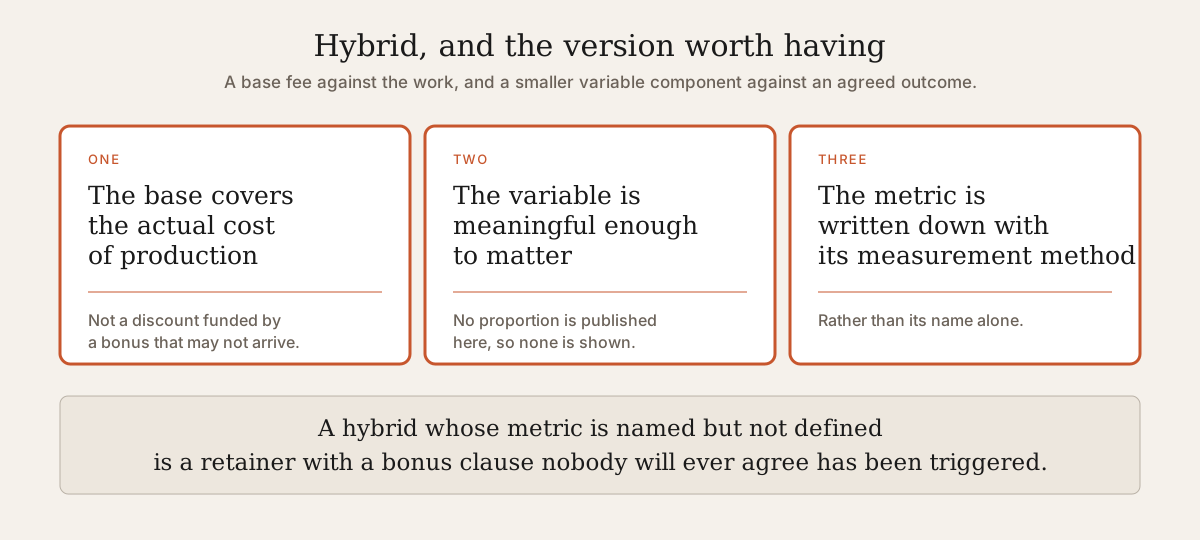
A hybrid puts a base fee against the work and a smaller variable component against an agreed outcome. It is the most common serious answer, and the useful version has three properties: the base covers the actual cost of production, the variable is meaningful enough to matter, and the metric is written down with its measurement method rather than its name alone.
A hybrid whose metric is named but not defined is a retainer with a bonus clause nobody will ever agree has been triggered.
What each model lets you enforce
Each charging model makes a different thing enforceable, and that is what decides your position when the work disappoints. A retainer buys availability, a project buys a defined deliverable, and a performance arrangement buys an outcome while moving risk onto the agency. Same money, three different things you can hold them to.
A retainer makes availability enforceable, and not much else. You have bought a team’s time for the month. If the output is thin you can raise it, but the contract says hours and attention rather than results, so the conversation is about effort rather than a missed commitment. This is why the scope document matters more on a retainer than on anything else.
A project makes the deliverable enforceable. The thing was defined before you signed, so it either exists to specification or it does not, and that is a short conversation. What you cannot enforce is what happens next, because nothing in a project obliges anyone to keep the result working.
A performance arrangement makes the outcome enforceable and moves the risk. If the number is not hit, the agency carries part of the cost. The trade is that the number has to be defined tightly enough to settle a dispute, and outcomes worth paying for are usually the ones hardest to attribute cleanly to one vendor.
Ask these five before signing, whichever model you are offered. Asked what to check before committing to a monthly retainer, one assistant answered: ask “what exactly is included, what is out of scope, who will do the work, how success is measured, and how” the arrangement ends. Those five hold for all three models.
- What exactly is included. In countable units, not categories. Content strategy is not a quantity.
- What is out of scope. The answer that costs money later is the one nobody asked for in advance.
- Who will do the work. The person in the pitch is not always the person on the account.
- How success is measured. Agree the metric and its source before the first invoice, not after a disappointing quarter.
- How you leave. Notice period, what you keep, and whether anything switches off when you stop paying.
We publish our own terms rather than describe other people’s, and we would rather a buyer arrived with these five answered than take a retainer that was never going to hold.
Matching the model to the situation
Continuous, cumulative work in a contested market. Retainer, with quantities named.
A defined piece of work with a visible end. Project, priced fixed.
A metric that is unambiguous and close to revenue. Hybrid with a real variable.
An outcome produced by a system neither side controls. Retainer, and treat a performance guarantee against that outcome as a warning rather than a benefit.
The mismatch that causes the most trouble is continuous work sold as a project, because it produces a handover at exactly the point where the work should be compounding.
What we do
We charge a monthly retainer with the scope named in quantities, and no performance component, because the outcome we work toward is produced by systems we do not operate and writing a guarantee against those would be writing a promise we cannot enforce. What we commit to instead is the production volume and the measurement, both of which are ours to control.
That is a model that suits us, and a buyer should read it as such and ask what it would take to make the variable real. Charging model is one of three commitment questions that vendors tend to present as one, and separating cost, model and term is most of what the fourth check involves.
SEO Is My Love Language was founded by Jose Villalobos, who has spent his career on a single discipline: getting businesses found, cited, and recommended by AI search. He has been a member of Koray Tuğberk Gübür’s Holistic SEO Community since 2022, is a graduate of the Topical Authority Course, holds the Google AI Professional Certificate, and is a member of Kyle Roof’s IMG. That combination, topical authority strategy paired with rigorous on-page execution, is what our team brings to every business we work with.
One category makes this argument better than we can, because the conflict is not between a buyer and a supplier but inside a single clinical sentence: the chiropractic version, where the recommendation is also the invoice. Law firms are the category being sold performance pricing by people who already charge it: a firm on contingency knows exactly what a percentage of an outcome does to the incentives of the person quoting it.
Frequently asked questions
How do marketing agencies charge?
Through four models: a monthly retainer buying capacity, a fixed project price for work with a defined end, performance pricing tied to an agreed metric, and a hybrid of base plus variable. Each places the risk differently, and the right one depends on how predictable the work is.
Is a retainer or a project better for SEO?
A retainer, for anything continuous and cumulative, because the value comes from sustained publication and a project ends at handover, usually before the result appears. A project price suits defined work with a visible end, such as a rebuild, an audit or a migration.
Should I look for performance-based pricing?
Only where the metric is unambiguous, attributable and close to money. Rankings and AI answer placements are produced by systems neither party controls, so a clause written against them is a bet on a third party. Performance clauses often measure a proxy instead, and a lead-based one shifts the incentive toward volume over quality.
What makes a hybrid arrangement work?
Three things: a base that covers the real cost of production, a variable large enough to matter, and a metric written down with its measurement method rather than only its name. A hybrid whose metric is named but undefined is a retainer with a bonus nobody will agree has been triggered.
What is the most common pricing mistake?
Buying continuous work as a project. The engagement ends at handover, which is usually before any result appears, and the buyer is then asked to purchase a second project to sustain the first.
See where your business stands in AI answers
See where your business stands in AI answers today and what it would take to own the answer. Book a strategy call and we will show you.