Local SEO for Personal Injury Lawyers: The Map Pack, the Office Address and the City Page
Local SEO for personal injury lawyers is the part of search visibility that is decided by place: which firm appears in the Google map pack, in the “near me” results and in the local answer an assistant gives to someone in a particular city, which is to say whether each office is found and named when someone nearby searches for an injury lawyer. It is won office by office. Each staffed office has its own Business Profile, its own address that has to match everywhere it is listed, its own reviews and its own city page, so a firm with three offices is in three separate local contests. The firm-wide program behind all of this, the channels, the content and the authority that carry a firm beyond any one city, is seo for personal injury attorneys. This page covers only what is decided locally.
For an injury firm the local contest matters more than in most practices, because almost every client wants a lawyer who knows their courts and their city, and on a phone the map pack sits above everything else. The same holds when the question goes to an assistant. Asked which personal injury lawyer nearby takes car accident cases, it returns a short answer naming one or two firms, and the records it can check a firm’s location against are largely the ones the map pack reads: the profile, the listings, the reviews and the city page.
What Local SEO for Injury Firms Covers
The foundation of local visibility is a set of signals that Google and, increasingly, AI systems read to decide which firm to surface for a given city. Get these right and you are in the running. Ignore them and no amount of AI strategy will save you.
Google Business Profile and the map pack
Your Google Business Profile is the single most important local asset you have. A complete, accurate, actively managed profile is what earns a spot in the map pack, the block of local results that sits above the traditional links. Categories, service areas, hours, photos, and a steady stream of activity all feed it. For an injury firm, this is the front door, and a neglected profile is a door left locked.
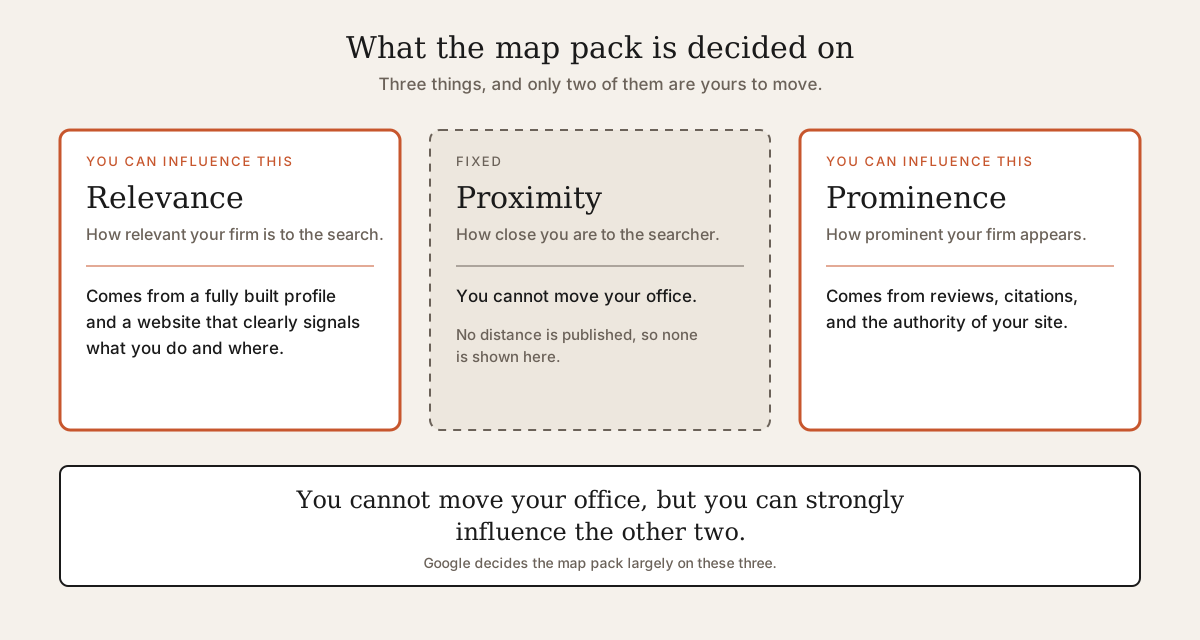
Google decides the map pack largely on three things: how relevant your firm is to the search, how close you are to the searcher, and how prominent your firm appears to be. You cannot move your office, but you can strongly influence the other two. Relevance comes from a fully built profile and a website that clearly signals what you do and where. Prominence comes from reviews, citations, and the authority of your site. Firms that treat the profile as a set-and-forget listing lose to firms that manage it as the living asset it is, and in injury, where the map pack sits in front of high-value cases, that neglect is expensive.
Two rules in Google’s guidelines for Business Profiles decide more than most firms expect. The first is the address. A virtual office, a mailing address the firm does not work from, is not eligible for a profile, and a mailbox at a remote location is not acceptable, so a satellite “office” that nobody staffs is a profile at risk of removal rather than a second chance to appear. The second is categories. The guidelines ask for the fewest categories that describe the core business and rule out categories used as keywords, so the primary category should name the cases the office most wants rather than every practice area the firm has ever handled.
Local citations, consistency, and reviews as trust signals
Beyond the profile, local search rewards consistency and reputation. Your firm’s name, address, and phone number need to match everywhere they appear online, because mismatches make search systems less confident about who you are and where you operate. Those same mismatches are what make a reader ask whether the firm is still operating. Reviews count locally in two ways at once: as one of the prominence signals the map pack reads, and as the thing a nervous client reads before calling. Each office’s reviews sit on that office’s profile, so a firm cannot lend one location’s reputation to another. Recency matters as much as the total. A profile with forty reviews and none in the last year reads as an office that has stopped asking, both to Google and to the person comparing it with the firm next to it in the pack.
Location-specific content that earns local relevance
Search systems connect firms to places through content. Pages that speak to your specific city, its courts, its roads, and the kinds of cases that happen there tell both Google and AI engines that you genuinely serve that area. Thin, generic pages that could belong to any firm in any city do the opposite. In our experience this is where most injury firms leave the easiest wins on the table, publishing the same interchangeable copy as everyone else and wondering why the map pack ignores them.
SEO Is My Love Language was founded by Jose Villalobos, who has spent his career on a single discipline: getting businesses found, cited, and recommended by AI search. He has been a member of Koray Tuğberk Gübür’s Holistic SEO Community since 2022, is a graduate of the Topical Authority Course, holds the Google AI Professional Certificate, and is a member of Kyle Roof’s IMG. That combination, topical authority strategy paired with rigorous on-page execution, is what our team brings to every business we work with.
How “Near Me” Search Changed: Local AI Answers
The traditional local playbook is necessary but no longer sufficient, because the “near me” search itself has changed. This is the gap the competition has not caught up to.
Why “near me” now surfaces AI Overviews
When we pulled the live results for local injury-lawyer searches, Google returned an AI Overview. That means the moment a prospect searches, an AI-generated summary can appear above the map pack and the links, framing the answer before the client ever scrolls. If that summary draws from firms other than yours, you have lost the client at the very top of the page, no matter how good your map ranking is. The old finish line, a top spot in the map pack, now sits below a newer, more prominent answer.
How AI assistants choose which local firm to name
For a local question an assistant has two things to settle: that a firm handles injury cases, and that it is in the place the person asked about. The second is where local work does its job. A profile at a staffed address, the same name, address and phone number across the directories, and a city page that names the courts and roads the firm deals with all say the same thing about where the firm is. A firm whose records disagree gives an assistant less to confirm than a firm whose records all agree.
What this means in practice is that your local content has to do double duty. A page about car accident claims in your city should answer the real questions an injured local person asks, in plain language, while making unmistakable that your firm serves that specific area. That combination, genuinely local plus genuinely helpful, is what both the map pack and the AI answer reward. Thin location pages that swap out a city name and change nothing else fool no one, least of all an AI trained to spot exactly that pattern.
When Local SEO Is Worth It for an Injury Firm
Local SEO is worth it for an injury firm in proportion to its real presence in a place. The deciding factor is a staffed office where the firm wants to be found, because proximity to a verified location is the one map-pack factor no amount of work changes.
One office or several
A firm with one office competes in one city’s map pack and should put everything into that profile and that city page. A firm with several staffed offices has a separate local contest at each: a profile, a set of listings and a city page per office, each describing the cases that office actually takes. Where a firm practises in more than one state the city pages are the smaller half of the problem, and what makes a state claim real is the larger one.
The firm with no office in the city
A firm whose only address in a city is a virtual office or a mailbox has no eligible address for a profile there, so it has no listing of its own in that city’s map pack, and any appearance there depends on how close its real office is. Its local work is the organic half: a city page that answers what an injured person in that city needs to know, and accurate listings in the legal directories. That is a real route to local searches, and a slower one, because it competes in the results below the map pack rather than in it.
What “done for you” local looks like
Done for you means you are not managing profiles, chasing listing fixes, or writing city pages between client meetings. The profiles, listings and city pages are handled per office and measured per office, so you can see which locations appear in which map packs and which city pages bring in calls.
Local is one layer of the work rather than the whole of it, and the rest of the programme it sits inside takes in the intake, the referral sources and the reputation work that a local listing does not reach.
The map pack behaves the same way for any business tied to a place. A dental practice faces the identical mechanism across a shorter radius in local SEO for dentists.
Frequently Asked Questions
Does an office address matter for local search, or is a service area enough?
A staffed address in the city you want to rank in matters, because proximity between the searcher and the verified location is one of the strongest local ranking factors. A virtual office or a mailbox is a common shortcut and it is the one most likely to be suspended, which removes a firm from local results entirely.
Should an injury firm with several offices have a page for each city?
Yes, where each office is staffed and takes cases in that city, because each office competes in its own map pack and the city page is what ties the office to the place. A page for a city where the firm has no office is a different thing: it can still answer local questions in the organic results, but it does not give the firm a listing in that city’s map pack.
Is local SEO worth it for personal injury attorneys?
For firms with a genuine local presence, yes; for firms relying on a virtual address, it is poor value, because the factor doing the work is proximity to a verified staffed location. A firm with three real offices in a metro has three chances to appear; a firm with one address and three mailboxes has one.
How long does local SEO take for a personal injury firm?
Several months in most markets and longer where the metro is saturated with advertising firms. Profile verification and consistent details across directories move first, while the review and content signals that decide competitive positions accumulate over quarters rather than weeks.
What single local signal do injury firms most often get wrong?
Inconsistent name, address and phone details across directories, usually left behind by an office move or a rebrand. It is unglamorous, it is checkable in an afternoon, and it undermines every other local signal because the platforms cannot resolve which record is the firm.
See Where Each Office Stands
A local position can be checked. For each office we can show you which map packs it appears in for the searches that matter, whether its name, address and phone number agree across the directories, how its reviews compare with the firms beside it, and whether its city page says anything a competitor’s does not. Book a strategy call and we will go through it office by office.