Local SEO for Dentists: The Map Pack, the Profile, and the Radius
Local SEO for dentists is the work of winning the searches that happen inside a few miles of your chair, and for most practices it is worth more than everything else in search combined. It is how your practice gets found by the patients closest to it, and named when an assistant is asked for a dentist nearby. The map pack sits above the organic results, it captures the searches with the clearest intent to book, and it is decided by a different set of signals from the ones that rank a webpage.
That difference is the part practices miss. A site can be technically excellent and still be invisible in the map, because the map is reading your profile, your reviews, and your stated service area rather than your page titles.
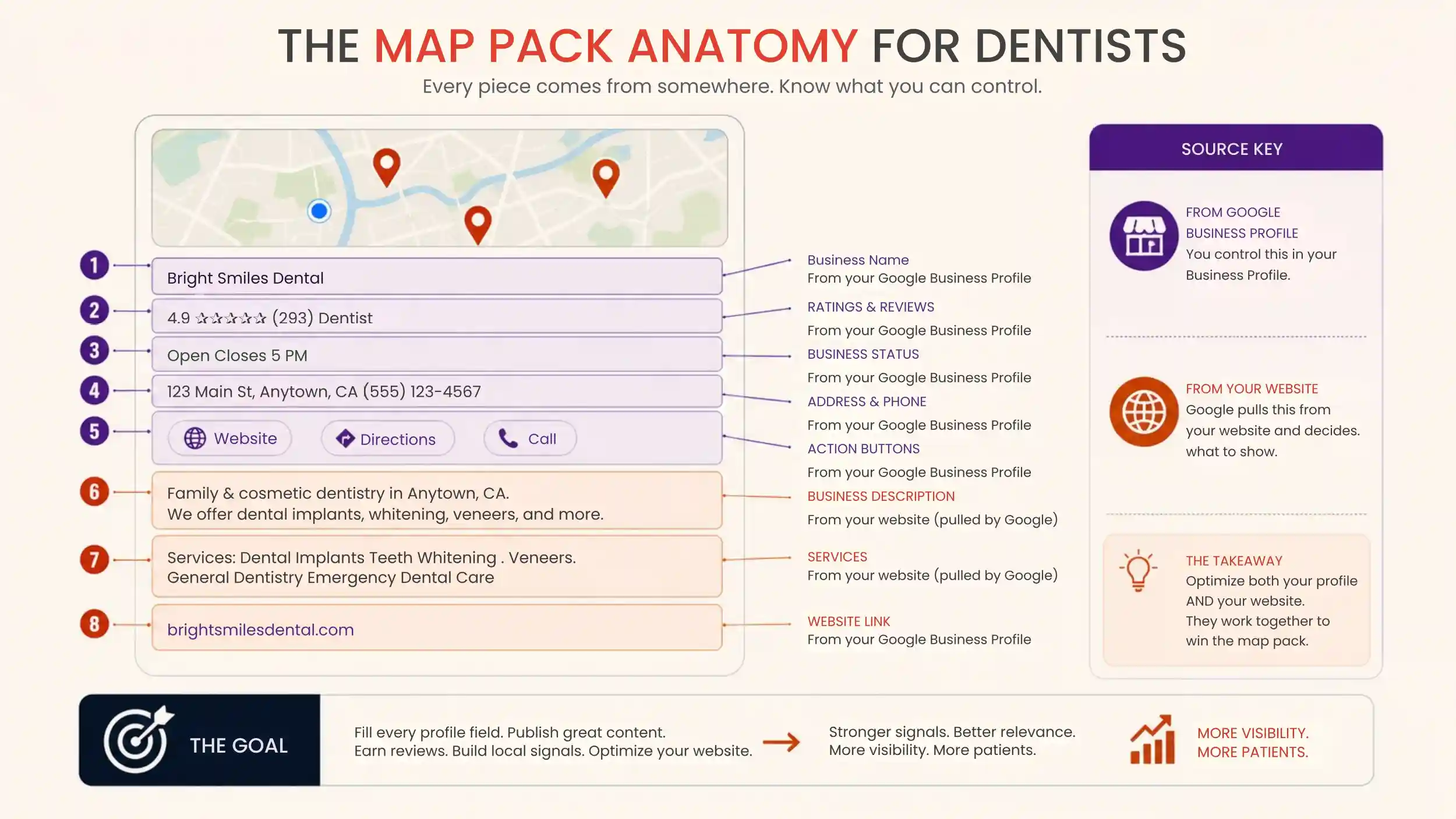
What local SEO means for a dental practice
Local SEO for dentists is the work of ranking in the map pack and local results for searches tied to your area, and it is driven mainly by your Google Business Profile, your reviews, and pages built for the places you serve. Those three do most of the work. The website supports them rather than the other way round.
Local results versus organic results
Local results are the map listings drawn from your Google Business Profile, while organic results are the blue links drawn from your website, and they are ranked by largely different signals. Proximity and reviews drive the first. Content and authority drive the second. A practice needs both, and most invest only in the second. Our guide to dental SEO covers that side.
Why the map pack matters more for dentistry
The map pack matters more in dentistry than in most categories because a patient will not travel far for routine care, so the search is inherently local and the map answers it directly. A first-page organic ranking below three map listings is a distant fourth in practice.
The Google Business Profile
Your Google Business Profile is the single asset that most determines local visibility, because it supplies the map listing, the review count, the hours, and the booking link. It is free, it takes an afternoon to set up properly, and it is the most neglected asset in dentistry.
Categories, services, and attributes
Set one primary category that matches your main practice type and add secondary categories only for services you genuinely provide, because category choice is one of the strongest map ranking levers available. Then list every treatment as a service. Practices routinely leave half their treatments unlisted.
Photos, posts, and what is worth maintaining
Photos of the actual practice, the team, and completed work are worth maintaining because patients use them to judge whether a place feels right, and profiles with real images convert better than those with stock. Posts matter far less. Update photos quarterly and ignore the pressure to post weekly.
Claiming and verifying a profile someone else set up
If a profile for your practice already exists and nobody at the practice controls it, you can claim it through the profile manager and verify ownership to take control. This is common after a practice sale or a marketing agency change, and an unclaimed profile is the most damaging single gap in local visibility.
Reviews and reputation
Reviews function as both a ranking signal and the deciding factor for the patient, which makes them the highest-leverage local asset a practice can build. Nothing else you control moves both numbers at once.
Volume, recency, and response
Volume and recency matter more than a perfect average, and a practice with 200 recent reviews at 4.7 will out-rank and out-convert one with 15 older reviews at 5.0. Respond to every review, including the good ones. Response rate is visible to both the patient and the algorithm.
Handling a negative review
Respond to a negative review calmly, publicly, and without discussing any clinical detail, then move the conversation offline. Patients read the response more closely than the complaint, and a measured reply frequently converts better than no negative reviews at all. Never mention treatment specifics; the privacy obligation does not pause because the review was unfair.
Service radius and location pages
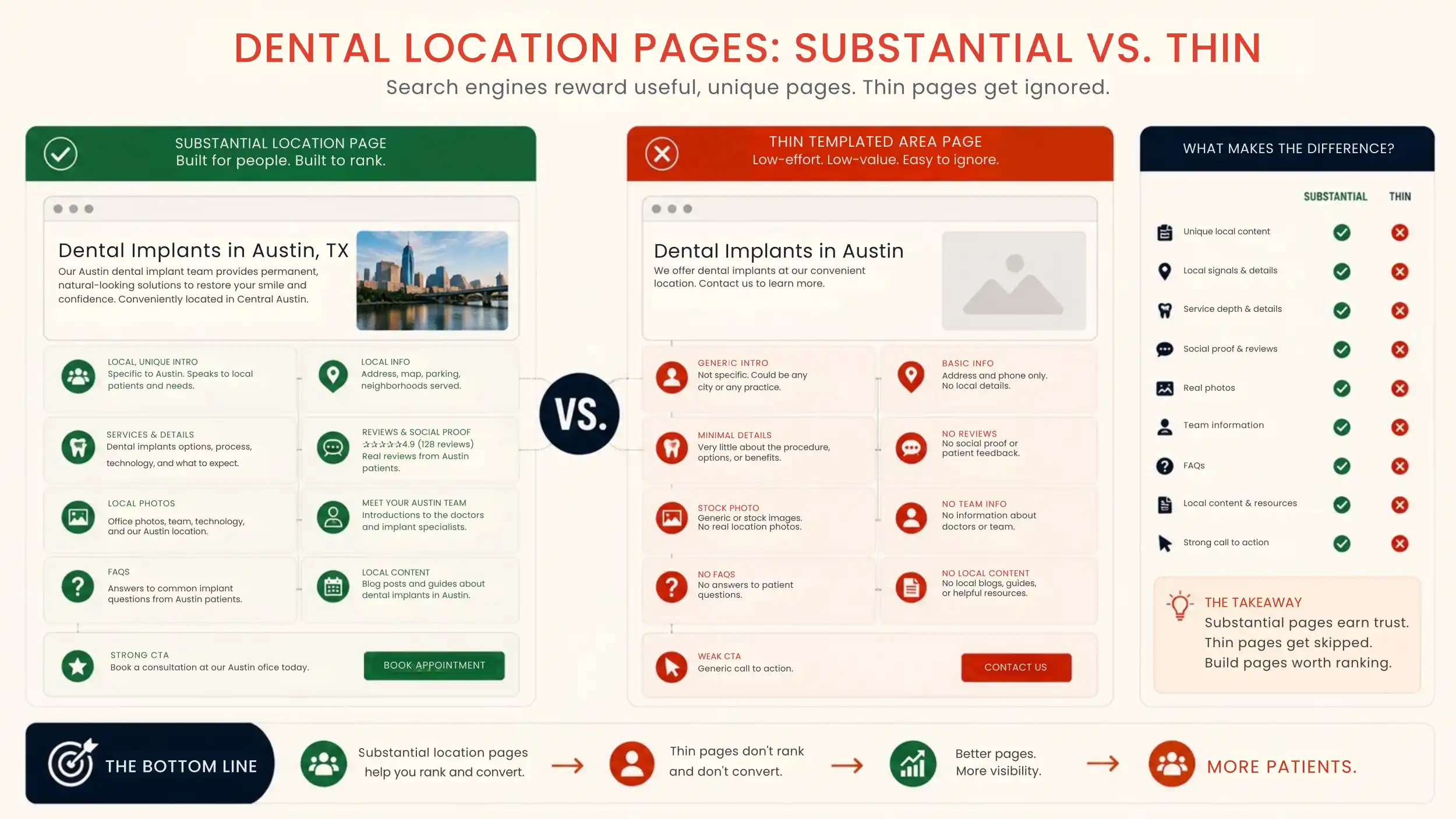
A location page earns its place only when the practice has a genuine claim to that area, and thin pages spun up for nearby towns tend to rank for nothing. We would rather see three substantial area pages than twelve template ones.
Single location, wide radius
A single practice serving a wide radius should build depth on the town it sits in and add area pages only where it can point to real patients, real travel patterns, or a genuine reason someone would drive. Claiming a fifteen-mile radius on the website does not create local relevance.
Multi-location and group practices
Multi-location groups need one profile and one page per physical site, each with its own address, hours, team, and reviews, because a shared page for several locations competes properly for none of them. Group practices lose more visibility to consolidation than to competition.
SEO Is My Love Language was founded by Jose Villalobos, who has spent his career on a single discipline: getting businesses found, cited, and recommended by AI search. He has been a member of Koray Tuğberk Gübür’s Holistic SEO Community since 2022, is a graduate of the Topical Authority Course, holds the Google AI Professional Certificate, and is a member of Kyle Roof’s IMG. That combination, topical authority strategy paired with rigorous on-page execution, is what our team brings to every practice we work with.
Local citations and consistency
Citation consistency matters less than it once did but still functions as a tiebreaker, so the practical goal is accuracy across the major directories rather than volume. Nobody should be selling you a five-hundred-directory submission in 2026.
The listings worth maintaining
The listings worth maintaining are the major aggregators, the dental association directories, and the insurance provider directories your patients actually use to find in-network care. Practices routinely keep the big aggregators current and forget the insurance ones, which is backwards, because a patient checking coverage starts there.
Local visibility in AI answers
When someone asks an assistant for a dentist nearby, the answer is assembled from local profiles, review content, and pages that clearly state where you are and what you treat, which makes local clarity an AI-visibility problem as well as a ranking one. The same ambiguity that costs you map rankings costs you the assistant answer.
What assistants read to answer a local question
Assistants answering a local question draw on business profiles, review text, and any page that states plainly where a practice is and what it treats, which means vague copy hurts twice. “Serving the greater metro area” tells a machine nothing it can use.
Making your service area unambiguous
State your city and neighbourhood in plain text on the pages that matter, name the areas you genuinely serve, and keep that list identical across your site and your profile. This is unglamorous and it is the highest-return AI visibility work available to a local practice. If you are deciding whether to run this yourself, our guide to dental SEO companies covers what to look for. Local visibility is one channel of thirteen that a practice is sold, and the measured size of each of them is what decides how much of a budget this deserves.
The map pack is one mechanism serving every local category. A law firm meets it with a wider catchment and a higher case value in local SEO for personal injury lawyers.
Frequently asked questions
What is local SEO for dentists?
Local SEO for dentists is the work of ranking in the map pack and local results for searches tied to your area, such as a treatment plus a city or the phrase near me. It is driven mainly by your Google Business Profile, reviews, and location-specific pages.
Is doing a local SEO worth it?
For a practice with a physical chair, local SEO is the highest-return channel available, because the map pack sits above the organic results and captures the searches with the clearest intent to book.
How do I find my Google Business Profile?
Search your practice name in Google while signed in to the account that manages it, or go to the Google Business Profile manager directly. If the profile exists but nobody controls it, you can claim it and verify ownership.
Is it worth having a Google Business Profile?
A Google Business Profile is the single most valuable free asset a local practice has. It supplies the map pack listing, the review count patients judge you on, and the hours and booking link that turn a search into an appointment.
Do I need an LLC for a Google Business Profile?
No. A Google Business Profile requires a real business presence and a verifiable address or service area, not a specific legal structure. Your practice can list under whatever entity it already trades as.
Get Your Practice Found by AI Search
The practices that win their local markets over the next few years will be the ones both Google and the assistants can describe without guessing. That comes down to being unambiguous about where you are and what you treat, everywhere it is stated. See where your practice stands in local and AI answers today. Book a strategy call and we will show you.