How to Verify an Agency Case Study
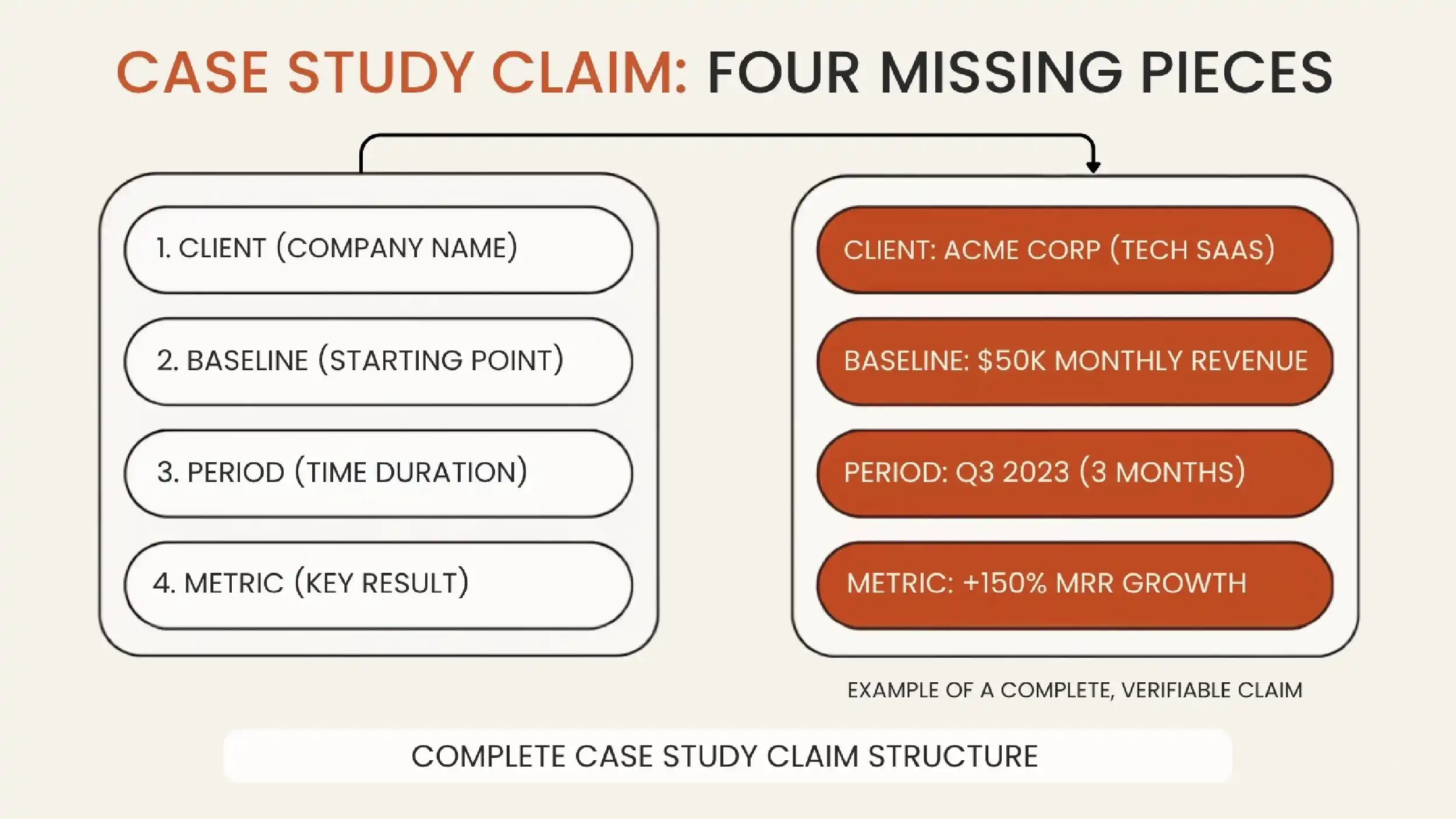
A case study you cannot check is a claim, and most published case studies are unverifiable by design rather than by accident. If the claim is that a client was found or named more often, you should be able to test it before you buy the same work. The missing pieces are consistent: the client is unnamed, the starting point is absent, the period is vague, and the metric is chosen after the fact. Any one of those makes the result impossible to confirm, and all four together make it impossible to falsify.
What has to be named
A checkable case study names the client, the starting number, the ending number and the window between them. Naming the client is the load bearing part, because everything else can be confirmed once you know who it was. An anonymous case study asks you to accept the arithmetic and the honesty at once.
Confidentiality is a real constraint and it has an honest form: a named client with a permitted subset of numbers, or an unnamed client with the explicit statement that the result cannot be verified. What fails is an unnamed client presented as evidence.
The four numbers usually missing
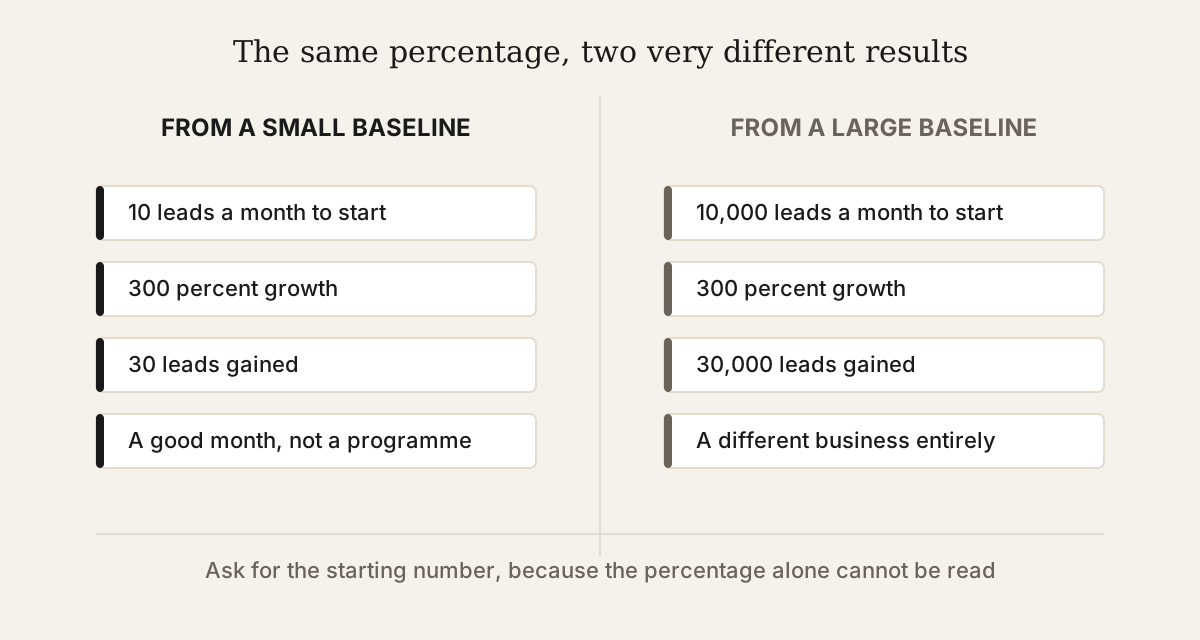
The starting number is the one most often absent, and without it a percentage means nothing. Traffic up three hundred percent from a base of eleven visits is arithmetic, not a result. Ask for the absolute figures at both ends.
The window is second. A gain measured across an unspecified period may cover a seasonal peak. The third is the counterfactual, which is what the trend was already doing before the work began. The fourth is what else changed, since a business that also started advertising has two explanations and one story.
How to check one in ten minutes
Search the client’s name and the claimed result together, because a genuine outcome usually leaves a trace beyond the agency’s own page. Then look at the agency’s other case studies for repeated figures. Identical percentages across different clients suggest a template rather than a measurement.
Then ask for a reference. A vendor confident in a case study will connect you to the client, and reluctance at that point is itself informative.
What we publish
We have no client case studies to show. The company is new, the work described on this site is our own, and inventing a named client would be the first dishonest thing on the page. What we publish instead is our own measured result, including the current one, which is not flattering. That reading is our own AI search visibility, measured and republished whichever way it falls.
That is a weaker proof than a named client outcome and it is the true one. When there is a client result to publish, it will carry the client name, both absolute numbers, the window and what else changed. Case studies, reviews and references are the three forms this evidence takes, and evidence is the second question rather than the first: what has to pass before any of it is worth examining is capability.
SEO Is My Love Language was founded by Jose Villalobos, who has spent his career on a single discipline: getting businesses found, cited, and recommended by AI search. He has been a member of Koray Tuğberk Gübür’s Holistic SEO Community since 2022, is a graduate of the Topical Authority Course, holds the Google AI Professional Certificate, and is a member of Kyle Roof’s IMG. That combination, topical authority strategy paired with rigorous on-page execution, is what our team brings to every business we work with.
We have run this check in public twice, on other people’s claims rather than our own, and both are readable end to end with the method attached: the dental vendor audit we published in full and the roofing vendor claims we checked ourselves.
Frequently asked questions
What makes a case study verifiable?
It names the client, the starting number, the ending number and the window between them. Naming the client is the load bearing part, because everything else can be confirmed once you know who it was. An anonymous case study asks you to accept the arithmetic and the honesty at the same time.
Is it acceptable for a case study to be anonymous?
Only if it says plainly that the result cannot be verified. Confidentiality is a real constraint with an honest form: a named client with a permitted subset of numbers, or an unnamed client with an explicit statement of that limit. What fails is an unnamed client presented as evidence.
Which number is most often missing from a case study?
The starting number, and without it a percentage means nothing. Traffic up three hundred percent from a base of eleven visits is arithmetic rather than a result. Ask for absolute figures at both ends, the window they cover, what the trend was doing beforehand, and what else changed during the period.
How can I check a case study quickly?
Search the client name and the claimed result together, because a genuine outcome usually leaves a trace beyond the agency’s own page. Then compare the agency’s other case studies for repeated figures, since identical percentages across different clients suggest a template. Then ask for a reference, because reluctance at that point is informative.
Does SIMLL have client case studies?
No. The company is new and inventing a named client would be dishonest. What we publish instead is our own measured result, including the current unflattering one. When there is a client result to publish it will carry the client name, both absolute numbers, the window, and what else changed.
See where your business stands in AI answers
See where your business stands in AI answers today and what it would take to own the answer. Book a strategy call and we will show you.