Dental Marketing: What a Practice Budget Is Actually Buying
Dental is the only category we have measured where every marketing channel carries real demand, which sounds like good news and is actually the problem. Every one of those channels is buying the same thing, which is your practice found when a patient searches and named when an assistant answers. When all thirteen channels are live, a practice can spend its entire budget on defensible choices and still lose, because the question stops being which channels work and becomes which ones work for this practice at this size.
What dental marketing actually is
Dental marketing is the work of being the practice a person chooses when they need a dentist and have no strong reason to prefer one over another. That is a different job from most local services, because the decision is rarely urgent, frequently deferred, and heavily influenced by one factor almost entirely outside the practice’s control, which is insurance.
The category also has a structure most local services lack: a patient who joins stays for years and brings a family. That changes the arithmetic completely. A roofing company has to make each job pay for its own acquisition, while a dental practice can afford to acquire a patient at a loss and recover it over a decade of recall visits.
The consequence is that dental marketing is judged on the wrong number more often than any category we work in. Cost per enquiry is easy to measure and nearly meaningless. Cost per retained patient, measured over years, is what decides whether a programme was worth running, and almost nobody calculates it.
Every channel is live, which is why budgets get spread thin
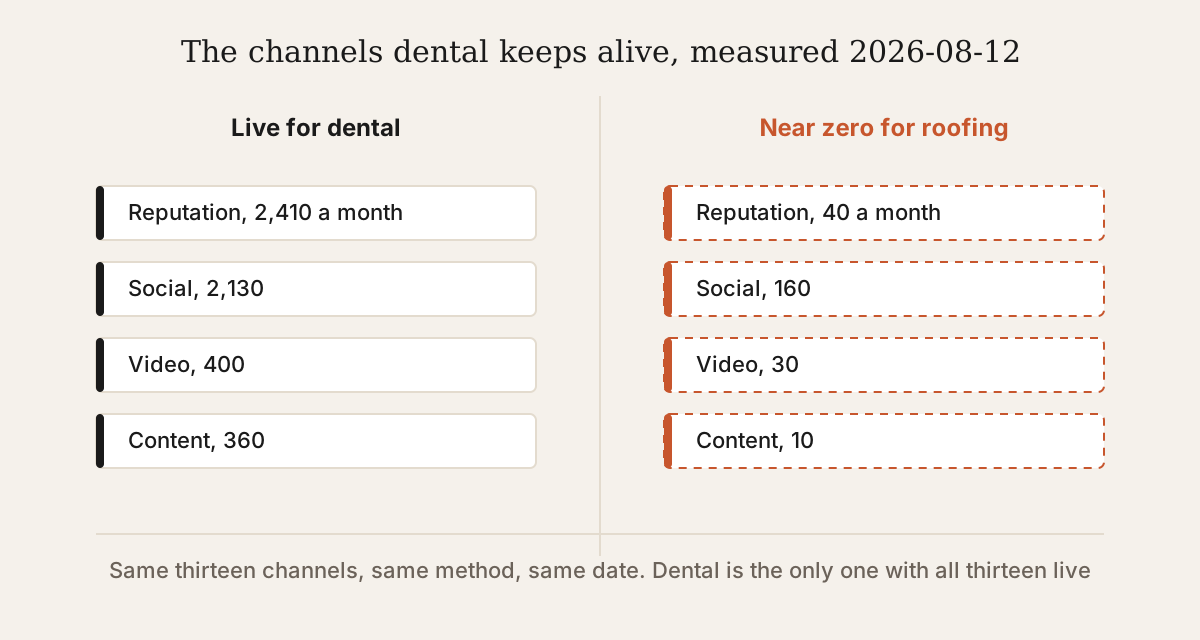
We measured 594 dental channel terms on 2026-08-12 across the thirteen channels a local practice is usually sold, and all thirteen carry monthly search volume. No other category we have measured has done that, including personal injury law.
Search, at 30,630 a month
Search is the largest channel by a clear margin and splits into the map results and the pages behind them. Insurance is the dominant modifier throughout, because a patient filtering by network is filtering before they are choosing, and a practice that does not state its networks plainly is excluded from consideration before it is compared. The two halves are covered separately: what dental SEO involves once the site is the thing being ranked, and how a practice appears in the map results and local answers.
The agency and website layer, at 43,530 a month combined
Marketing agency terms at 23,330 and web design at 20,200 together outweigh search itself, which tells you how much of the demand in this category is practice owners shopping for help rather than patients shopping for care. It also means the buying market is crowded and noisy, and that a practice owner researching agencies is being marketed to constantly.
Advertising and PPC, at 11,920 a month
Paid channels are substantially larger here than in most local categories, and they work, at a price that rises every year. The trap is that paid acquisition looks efficient on a first visit and stops looking efficient when the same patient is re-acquired because nothing was built to retain them. What dental advertising costs and what it buys sets out that arithmetic against the earned alternative.
Reputation, social, video and content, at 5,300 a month combined
These four are the ones that come back near zero in most categories and stay alive in dental. Reputation at 2,410 is the largest, which fits a category where a nervous patient reads reviews before booking, and social at 2,130 reflects a practice type that genuinely can show its work.
Intake, at 3,020 a month
Intake in dental is scheduling, reminders and recall, and it is closer to retention than to acquisition. A practice with a weak recall system is buying the same patients twice, which is the most expensive mistake available in this category and the least visible on a marketing report.
Insurance is the filter everything else sits behind
The single most-raised fact in the dental attribute work was insurance network participation, and it behaves less like a feature and more like a gate. A patient who has filtered to in-network practices is choosing among that set only, and everything a practice publishes about technology, comfort or credentials is read after that filter has already been applied.
This has a blunt implication for a website. Networks should be stated in plain text, current, and easy to find, because an unanswered insurance question is a lost patient rather than a deferred one. Practices frequently bury this in a PDF or leave it to a phone call, which converts a five second check into a barrier.
It also means a practice deliberately out of network has a different marketing job entirely, which is to make the case for paying more before the filter is applied. That is a content problem rather than an advertising problem, and it is one of the few places in dental where publishing genuinely changes the outcome.
Anxiety is a marketing subject, not a soft one
Dental anxiety, sedation and treating phobic patients appeared consistently in the attribute work as things patients ask about directly, and they are among the least well published subjects on dental websites. Practices tend to mention comfort in passing and move on to technology.
That is a missed opportunity, because a person searching for how a practice handles fear is describing a real barrier to booking and is unusually persuadable by a specific answer. What a practice does at the first visit for an anxious patient, whether sedation is available and what it involves, and what happens if somebody needs to stop partway are all answerable in plain language and almost never answered.
We would publish those before publishing anything about equipment. A patient afraid of the chair is not reassured by a scanner.
Buy patients or earn them, and the honest comparison
Paid acquisition in dental works and will keep working, and it costs more each year. Earned visibility takes months, produces nothing early, and then produces patients without further spend. The difference in this category is that the lifetime value is high enough that both can be justified, which is exactly why practices end up doing both badly.
The comparison that settles it is cost per retained patient at twenty four months, not cost per enquiry. A practice that measures the second number will always conclude that paid wins, because paid produces enquiries quickly and earned produces them late. A practice that measures the first frequently finds the opposite.
We would not recommend replacing paid acquisition with earned visibility in one step. We would recommend building the earned layer while paid runs, and letting the measured cost per retained patient decide the split rather than a preference.
What we would build first
We would fix the insurance question first, because it gates everything else, and it is usually a half day of work rather than a project. Then the anxiety and first visit pages, because they are the highest intent and least contested subjects in the category.
Then the recall and retention layer, which is not marketing in the usual sense but is where dental economics actually live. A practice that retains an extra ten percent of its patients has done more for its revenue than a campaign that raises enquiries by a third.
We sell these services, so read the argument as coming from an interested party and check it against the measurement. The channel figures above are reproducible: 594 terms, US volumes, measured 2026-08-12.
The pages a practice needs, in the order a patient needs them
Before anything else a patient has to establish that they can come to you at all. That starts with whether you are taking anyone new and runs straight into the insurance question that filters every later comparison. Two more gates sit beside it and are almost never published: whether the hours fit somebody who works, and what the building and the appointment can accommodate. A parent checking for a child needs the ages the practice actually treats stated plainly rather than implied by the word family.
Then cost, which stops more treatment than fear does. What a filling or a crown actually costs can be answered honestly more often than practices believe, and what happens when a patient cannot pay for it at once is the page that turns a deferred treatment into a booked one.
Then who is doing the treating. Patients are told to check that a dentist is licensed and almost no practice site makes it easy, so publishing licensure so it can actually be verified does work that a credentials paragraph does not. What specialist means and when it may be claimed is a compliance question as much as a marketing one, and showing training without listing every weekend course is the version of it a patient can read. Reviews, and how a practice asks for and answers them carries constraints in dental that general review advice ignores.
Then what the practice does. A services list that shows what the practice is good at rather than reading as a menu, what gets referred out and to whom, which patients ask directly and which changes their decision, how to write about elective work without overselling it, and which equipment is worth naming at all, which is a far shorter list than most technology pages suggest.
Then the chair itself, which is where this category is least well served. What to say to somebody who has been avoiding the dentist for years is a different page from what a practice that genuinely handles severe phobia can offer, and both are different again from what each sedation option actually involves, which patients search by name and most sites answer with one word.
And last the part that decides whether any of it paid for itself: the four things patients mean when they say good communication, which is recall and retention wearing a softer name. That is also where the practice’s own evidence comes from, which splits in two: what a practice can publish as a result, and what it cannot covers the consented, regulated half, and publishing outcomes a patient can verify covers the half that needs no consent and that almost nobody in dentistry publishes.
If the question is whether to hand this to somebody rather than build it, how the dental SEO vendor category splits and what separates the serious firms sets out that comparison.
We published the whole thing for one market: the ninety one page programme we would build for a Sacramento practice, with the source behind every page named.
Why the agency layer is bigger than the patient layer
The most surprising figure in the dental measurement is not about patients at all. Marketing agency terms at 23,330 and web design at 20,200 total 43,530 monthly searches, which is larger than the 30,630 for search itself. More people are searching for someone to do dental marketing than are searching in the way dental marketing is meant to capture.
That tells you the market you are buying in is crowded and noisy, and that a practice owner researching help is being marketed to constantly by people who have read the same advice. It also explains why so much dental marketing sounds identical: it is sold into a market where the buyer compares proposals rather than outcomes, and proposals converge.
The practical defence is to compare on what a proposal commits to rather than what it claims. Who does the work, what is produced each month, how success is measured, and what happens when you leave are all checkable before signing. Best in class and proprietary methodology are not, and they appear on every proposal in the category.
Independent practice against group ownership
Consolidation changes what dental marketing is for, and the measurement hints at it. A practice being courted by a group and a practice competing against one are running different plays, and generic dental marketing advice is usually written for neither.
An independent practice competes on the things a group cannot easily replicate: continuity of clinician, a named dentist the patient sees each time, and local specificity. Those are publishable facts and they are exactly what tends to be omitted in favour of technology lists that a group can match with more capital.
A group-owned practice has the opposite problem. It has scale and process advantages that are real, and a marketing job that has to make a standardised experience feel like a chosen one. Both are legitimate positions. What does not work is an independent practice marketing itself as though it had group resources, because the claim collapses on contact.
Membership plans, and the shift away from insurance
Membership plans carried 1,900 monthly searches in the dental measurement of 2026-08-12, which makes them the largest single term outside the standard channels and larger than several channels in their entirety. That is a signal about where the category is moving rather than a marketing tactic.
A membership plan is a practice selling access directly rather than through an insurer, and it changes the marketing job completely. The insurance filter described above stops applying, because the patient is no longer sorting by network. What replaces it is a straight value comparison, which a practice can actually influence with what it publishes.
This is one of the few places in dental where content changes the outcome rather than describing it. A practice with a plan has to explain what it covers, what it costs, how it compares to the insurance the patient already has, and what happens if they need something the plan excludes. Those are four pages nobody in the category writes well, and the search demand for them already exists.
We would also be honest that a plan is not a universal answer. It suits practices with a stable local patient base and it is difficult for a practice whose volume depends on being in a large network. The measurement shows demand, not suitability.
Dental is unusual twice over, because the service lines carry volume too
Most categories carry depth in one axis only. Trades carry it in channels while their sub-trades come back near zero, and medical practices usually carry it in service lines while their channels are shallow. Dental carries both, which is why it produces more legitimate pages than any category we have measured.
The channel axis is the thirteen live channels described above. The service line axis is separate demand for implants, orthodontics, cosmetic work and sedation, each of which is a distinct decision with its own research pattern and its own competitors. A patient researching implants is not the same buyer as a patient looking for a checkup, even when both end up in the same chair.
The practical consequence is a sequencing decision rather than a bigger budget. A practice can build across channels, or it can build depth on the one or two service lines that carry its margin, and doing both at once is how dental marketing budgets get spread thin enough to produce nothing.
We would generally start with the service line that carries the practice’s profit rather than the one that carries the most searches. Volume without margin is how a practice ends up busy and no better off.
The three layers of visibility a dental practice needs
Dental visibility has three layers and they fail independently, which is why a practice can be busy on one and invisible on the others without noticing until growth stalls.
The map layer is the Google Business Profile and the local pack it feeds, won by proximity, correct categories, review volume and recency. Most practices already work this layer, and its limitation is that it only appears for a narrow band of highly commercial searches.
The page layer is whether the site answers questions rather than listing services. Insurance networks in plain text, what the first visit involves, how anxiety is handled and what a treatment costs before insurance are the questions patients bring, and most dental sites answer none of them directly.
The answer layer is where a patient asks an assistant which dentist near them takes their insurance and treats nervous patients. The assistant assembles that from pages it can read. A practice that exists only in the map layer has nothing quotable and is absent from the answer entirely.
What done for you actually looks like in dental
Done for you in dental usually means somebody posts, sends a report and buys some ads. What it should mean is that the insurance question is fixed first, because it gates everything else and it is usually half a day of work rather than a project.
After that the sequence is unglamorous and it compounds. The first visit and anxiety pages, then the pages that answer cost questions honestly, then the recall and retention layer that decides whether acquired patients are worth what they cost. None of that produces a chart that moves in month one, and all of it is what months six through twenty four are built on.
The middle period is where dental programmes are usually cancelled, because paid acquisition has already produced visible enquiries and the earned layer has not yet produced anything. We say that in advance rather than in a retention conversation, because a practice that cancels at month three has paid for the expensive half and skipped the part that returns.
What we will not do is promise a placement. Nobody controls what an assistant says, and any agency promising a specific model will name your practice is describing something it cannot deliver. What can be built is the corpus that makes being named possible, and what can be measured is whether it is happening.
Frequently asked questions
Which marketing channel works best for a dental practice?
Search is the largest at 30,630 monthly searches measured 2026-08-12, but dental is unusual in that all thirteen channels we tested carry demand. The useful question is not which channel works but which works for a practice of your size and network status.
Why does insurance matter so much in dental marketing?
Because it acts as a filter applied before comparison. A patient filtering to in-network practices only compares within that set, so everything else a practice publishes is read afterwards or not at all.
Is dental marketing more expensive than other local services?
Paid acquisition is, and it rises annually. What offsets it is patient lifetime value, which is high enough that acquisition costs which would be fatal in roofing are recoverable in dental if retention is working.
Should a practice measure cost per enquiry?
It is the wrong number on its own. Cost per retained patient measured over about twenty four months is what determines whether a programme paid for itself, and it frequently reverses the conclusion that cost per enquiry suggests.
What should a dental website publish that most do not?
Insurance networks in plain current text, and a specific answer on how the practice handles anxious patients. Both are heavily asked and rarely answered, while equipment is rarely asked and usually featured.
How long does earned dental visibility take?
Months, with very little return in the first half of that period. That is why we would build it alongside paid acquisition rather than instead of it.
Get Found by AI Search
The dental practices that win their markets in the next few years will be the ones the AI answer names when a patient asks who to see, not the ones bidding against every other practice for the same click. That advantage is being built now by the practices that understood the shift early. See how we would get your practice found, cited and recommended by AI search. Book a strategy call and we will show you where you stand today and what it would take to be the practice the answer names.