Dental Advertising: Channels, Rules, and What Each One Costs
Dental advertising is everything a practice pays to appear in, and the decision that matters is not which channel is best but which one matches the treatment you are trying to fill. Each channel rents the chance to be found while the budget runs, which is a different thing from your practice being named in an AI answer. Paid search captures a patient who has already decided. Social creates interest that did not exist. Mail reaches a street. Those are three different jobs, and practices routinely buy one expecting another.
We should be direct about our own position, because it is the whole reason this page can be honest. We do not sell advertising. We do not place paid search, run paid social, buy direct mail or broker sponsorship, and we take no commission on any of it. We build AI-search visibility, which is earned rather than bought. That is precisely why we can say plainly where paid spend is the right answer and where it is money a practice will wish it had spent elsewhere.
There is also a constraint most marketing guides skip: dentistry is a licensed profession, so what you may claim in an ad is governed by professional conduct rules as well as by platform policy.
When we pulled the search results for this term, we found something unusual worth stating plainly:
There is no dedicated dental advertising page in the top ten results for the term. Of the three top-ranking results we extracted, one is an agency homepage, one is a general dental marketing guide, and one is the Association for Dental Safety, which ranks on a false match for the ADS acronym and carries 213 words. SIMLL analysis, July 2026, n = 10 organic results, 3 extracted.
How dental advertising works
Dental advertising covers every channel a practice pays to appear in, from paid search and social to mail and local sponsorship, and each one buys attention that stops when the budget does. That last clause is the whole economic story. Advertising rents a position; it does not build one.
Paid attention versus earned attention
Paid attention arrives the day you switch it on and leaves the day you switch it off, while earned attention takes months to build and keeps producing afterwards. Neither is better. They are different instruments, and a practice needs both for different reasons.
What advertising can and cannot fix
Advertising can fix an empty schedule quickly and cannot fix a weak reputation, a slow phone, or fees that are out of step with the local market. Spend into any of those and you are paying to expose the problem to more people. We would fix the phone first, every time.
Paid search and local service ads
Paid search puts your practice at the top of results for treatments you choose, and local service ads charge per lead rather than per click while showing a verified badge. The badge does real work in dentistry, where the patient is choosing someone to put hands in their mouth.
How dental keyword costs behave
Dental keyword costs rise with treatment value, so a routine cleaning search is cheap and an implant or full-arch search is expensive, sometimes by an order of magnitude. Bid on the treatments whose economics justify it rather than on the ones with the most volume.
Local service ads and screening
Local service ads require a screening and verification process before they run, which is a barrier and also the reason the badge carries weight. Budget several weeks for approval. Practices routinely plan a launch around a channel they have not been approved for yet.
Paid social and community advertising
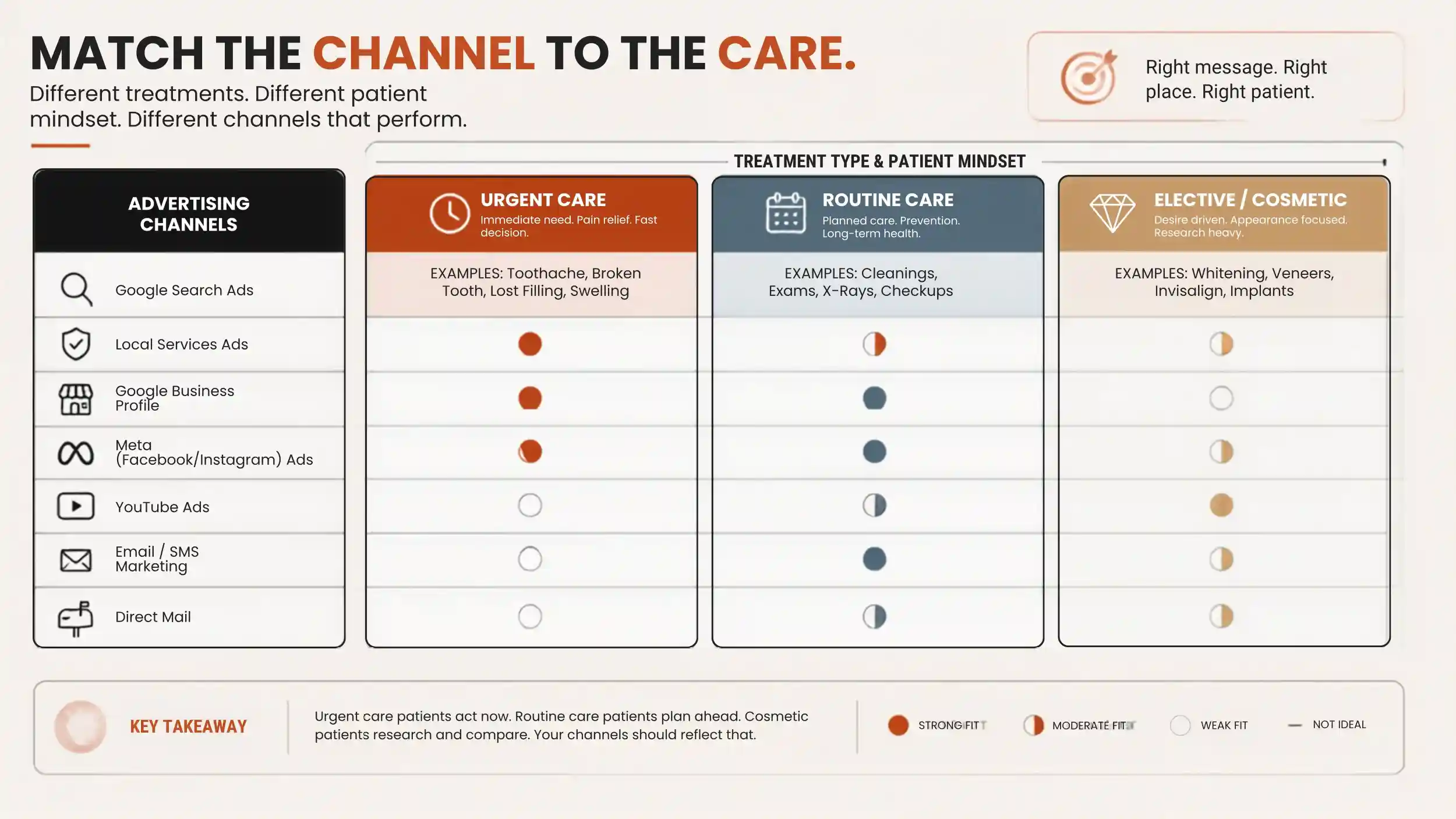
Paid social creates demand rather than capturing it, which suits elective and cosmetic treatments far better than urgent ones. Nobody with a broken tooth is scrolling. Someone considering aligners for a year might be.
Which treatments suit social advertising
Orthodontics, whitening, veneers, and implants suit social advertising because the decision is considered, discretionary, and often prompted rather than searched. Emergency and routine care do not, and social spend aimed at them usually underperforms paid search badly.
Before and after imagery and its limits
Before and after imagery is the most effective creative in elective dentistry and the most heavily constrained, because it implies an outcome another patient may not get. Use it with documented consent and honest framing about typical results.
Offline: mail, print, and sponsorship
Direct mail still works in dentistry for new-mover and new-practice campaigns, where the target list is genuinely local and the offer is concrete. Outside those two cases it usually underperforms its cost.
When mail outperforms digital
Mail outperforms digital when you need to reach a defined geography exhaustively rather than reach people showing intent, which is exactly the new-mover and new-practice situation. It only reports back if you give it a tracking number or a code to redeem, and without one the result is unknowable rather than disappointing.
Sponsorship and community presence
Local sponsorship buys visibility and goodwill in a defined community rather than measurable enquiries, and it should be budgeted as reputation spend rather than as acquisition. Judge it on whether people mention it, not on attributed bookings.
SEO Is My Love Language was founded by Jose Villalobos, who has spent his career on a single discipline: getting businesses found, cited, and recommended by AI search. He has been a member of Koray Tuğberk Gübür’s Holistic SEO Community since 2022, is a graduate of the Topical Authority Course, holds the Google AI Professional Certificate, and is a member of Kyle Roof’s IMG. That combination, topical authority strategy paired with rigorous on-page execution, is what our team brings to every practice we work with.
The rules dental advertising has to follow
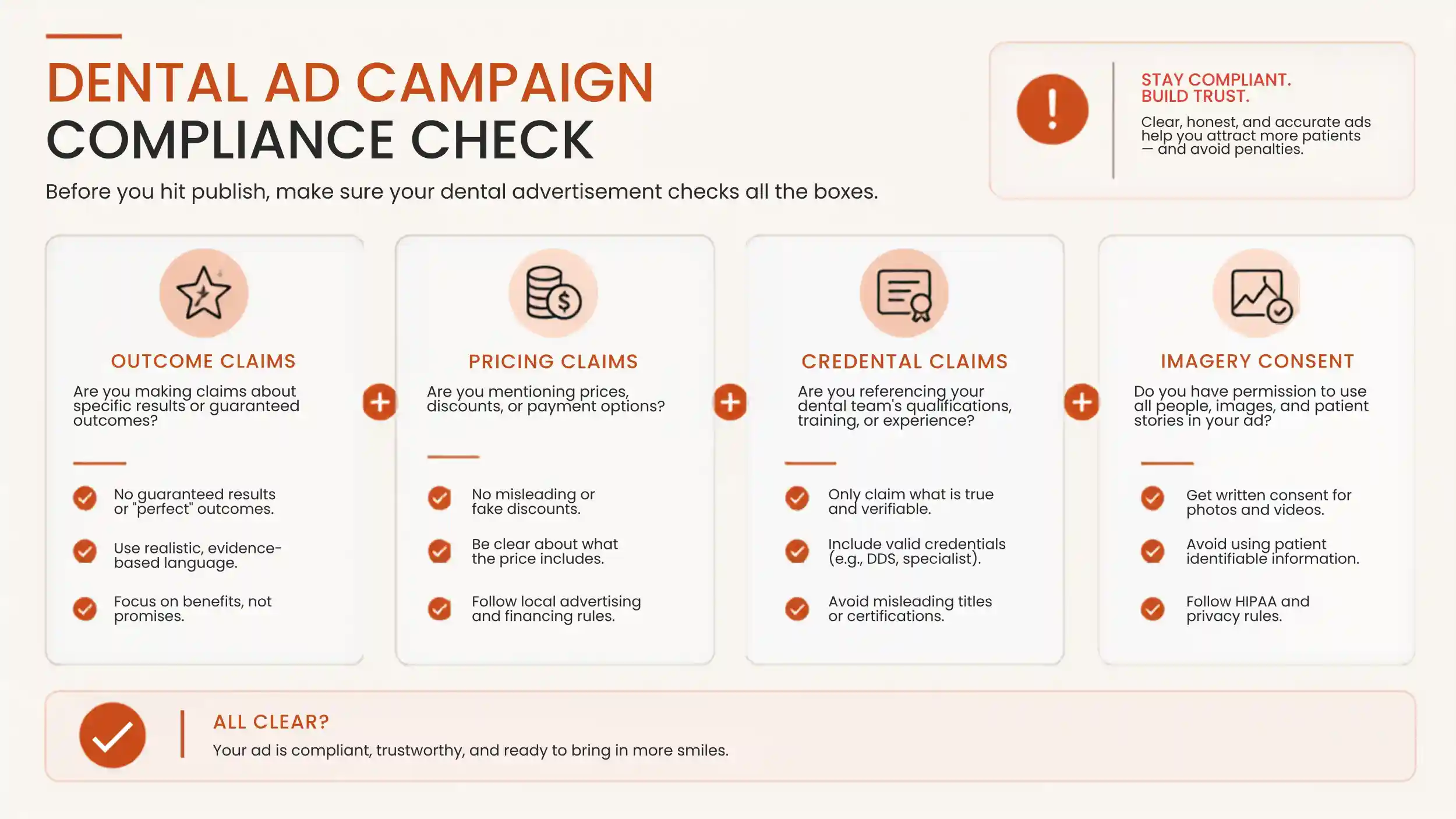
Dental advertising is constrained by professional conduct rules as well as platform policy, so claims about outcomes, pricing, and credentials carry real regulatory weight. This is the section most dental marketing content omits entirely, and it is the one with consequences attached. Rules vary by jurisdiction, so treat what follows as the shape of the problem rather than as legal advice.
Claims that create risk
Superlative claims, guaranteed outcomes, and specialty descriptions you are not formally credentialed for are the three that create the most risk. “Best dentist in town” is an opinion nobody can substantiate. A specialty title you have not completed the training for is a different order of problem.
Before and after images and consent
Before and after images need documented patient consent for marketing use specifically, not just clinical records consent, and they should not be retouched or presented as typical when they are not. Get it in writing and keep it with the asset.
What advertising costs and how to budget it
Practices commonly spend between three and eight percent of collections on marketing, with advertising spend sitting on top of any agency fee rather than inside it. Practices are surprised by that split more often than by the total.
Splitting budget between channels
Split budget by what each channel is for: paid search to fill near-term capacity, social to build a pipeline for elective work, mail only where geography justifies it. Reallocate quarterly rather than monthly, because the slower channels need time to show anything.
The cost per new patient question
Cost per new patient is the only advertising number worth reporting to an owner, and it is calculated from spend divided by patients who actually attended, not by enquiries. Enquiry counts flatter every channel. Attendance does not.
Why earned visibility makes paid spend cheaper
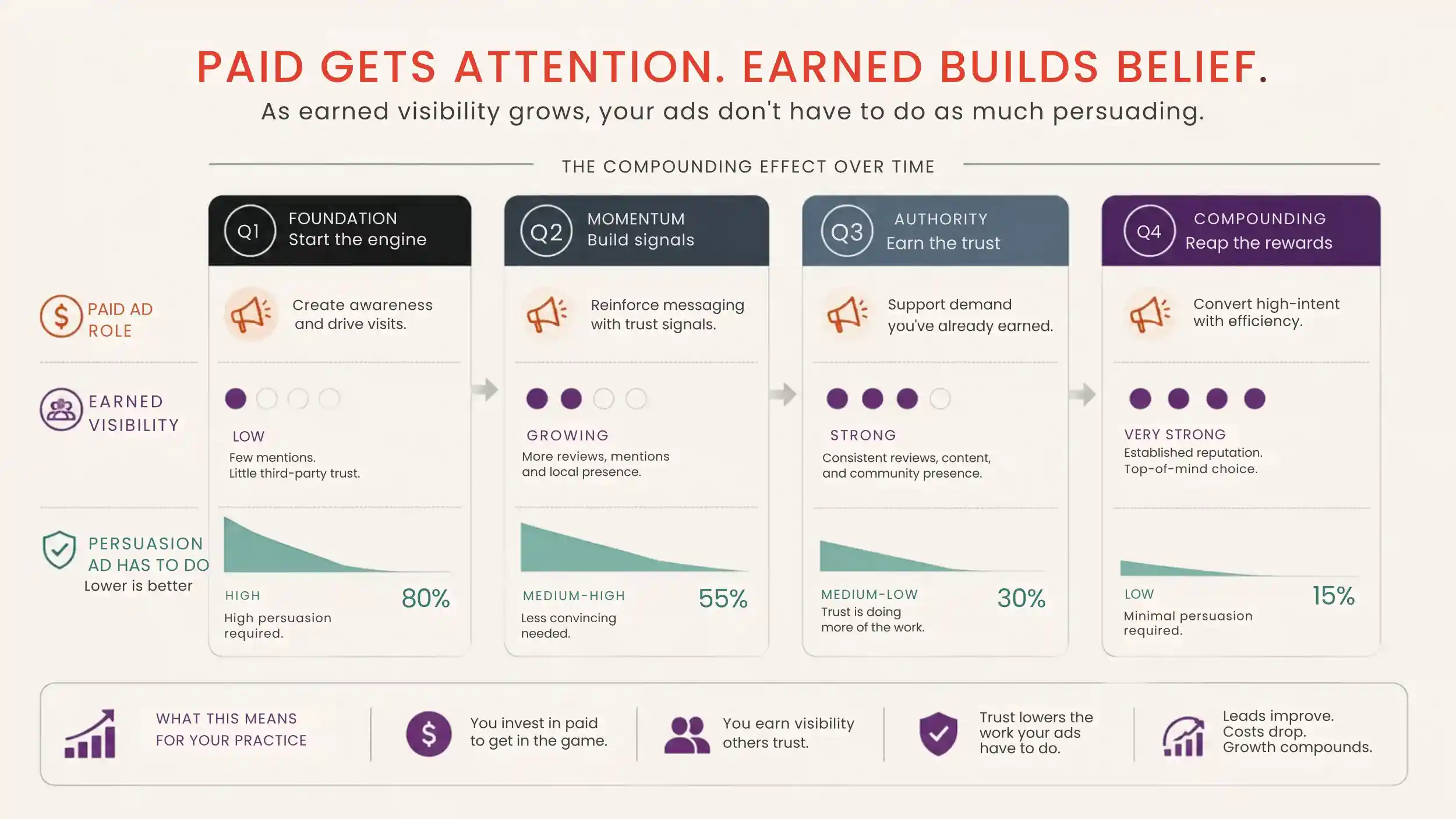
Paid advertising converts better when the practice already appears in organic results, reviews, and AI answers, because the patient has seen you before the ad and the ad no longer has to do all the persuading. This is the argument for not treating the two budgets as competitors.
The compounding effect of being findable
Being findable compounds: every month of organic and review work makes the next month of advertising convert slightly better, because recognition does part of the job the ad used to do alone. Our guide to dental SEO covers how that compounding gets built.
Where to put the next dollar
Put the next dollar into whichever stage is leaking most, which for most practices with running ads is conversion rather than reach. If you are still deciding across the whole category, our guide to dental marketing sets out the diagnostic order, and dental SEO companies covers who to hire once you know.
Frequently asked questions
How do dentists advertise?
Dentists advertise through paid search, paid social, local service ads, direct mail, and community sponsorship. Paid search captures people already looking for a treatment, while social and mail create demand that was not there yet.
Who is the best dental marketing company?
There is no single best dental marketing company, because the category splits into full-service agencies, paid-media specialists, website vendors, and visibility specialists. The right choice depends on which of those gaps your practice actually has.
How much does dental marketing cost?
Dental practices commonly spend between three and eight percent of collections on marketing, split across advertising spend and the agency or vendor fees that manage it. Advertising budgets sit on top of any retainer, not inside it.
What is PPC in dentistry?
In a marketing context, PPC means pay per click: you bid on searches such as a treatment plus your city and pay only when someone clicks. Note that PPC also has a clinical meaning in dentistry, the periodontal pocket chart, which is unrelated.
What is PPC ADA?
Pay per click is online advertising where you pay only when someone clicks your ad. The American Dental Association publishes guidance on advertising claims, so paid dental ads must stay inside professional advertising rules as well as platform policy.
Get Your Practice Found by AI Search
Advertising will fill next month. It will not make your practice the one an AI assistant names when a patient asks who to see, and that position is being decided now. Of the 31 pages we found dental marketing vendors publishing on AI search, checked July 2026, every one had zero ranking keywords, which we set out in full on our dental marketing page. See where your practice stands in AI answers today and what it would take to own the answer. Book a strategy call and we will show you.