Dental SEO: What It Covers and What It Now Has to Do
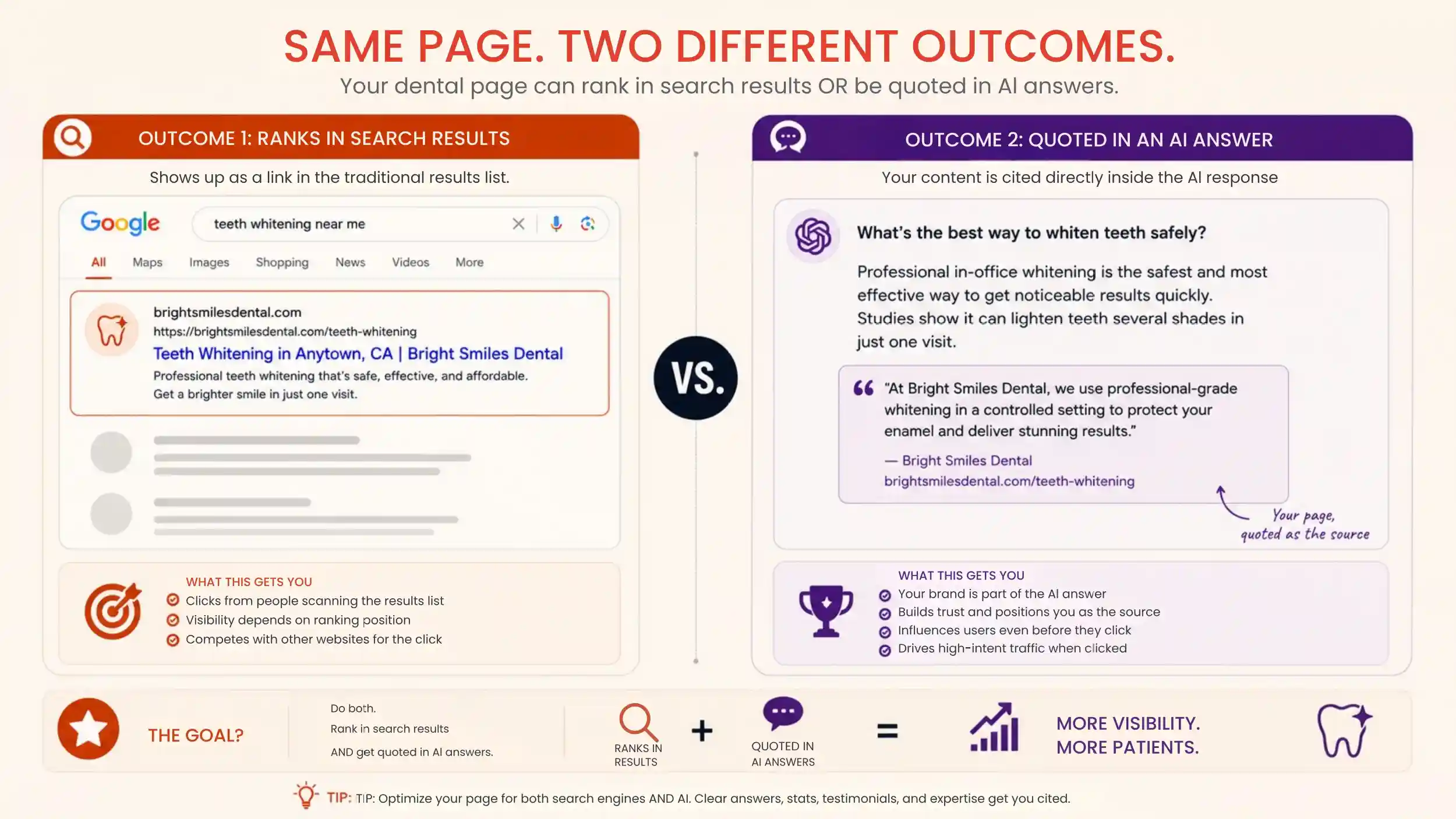
Dental SEO is the work of getting a practice found in search for the treatments it provides and the area it serves, and it now has two jobs rather than one. The first is ranking in the results a patient scrolls. The second is supplying the sentence an assistant repeats when it answers a patient without sending them anywhere. Most practice sites are built for the first job and were never built for the second, which is why this page treats them separately.
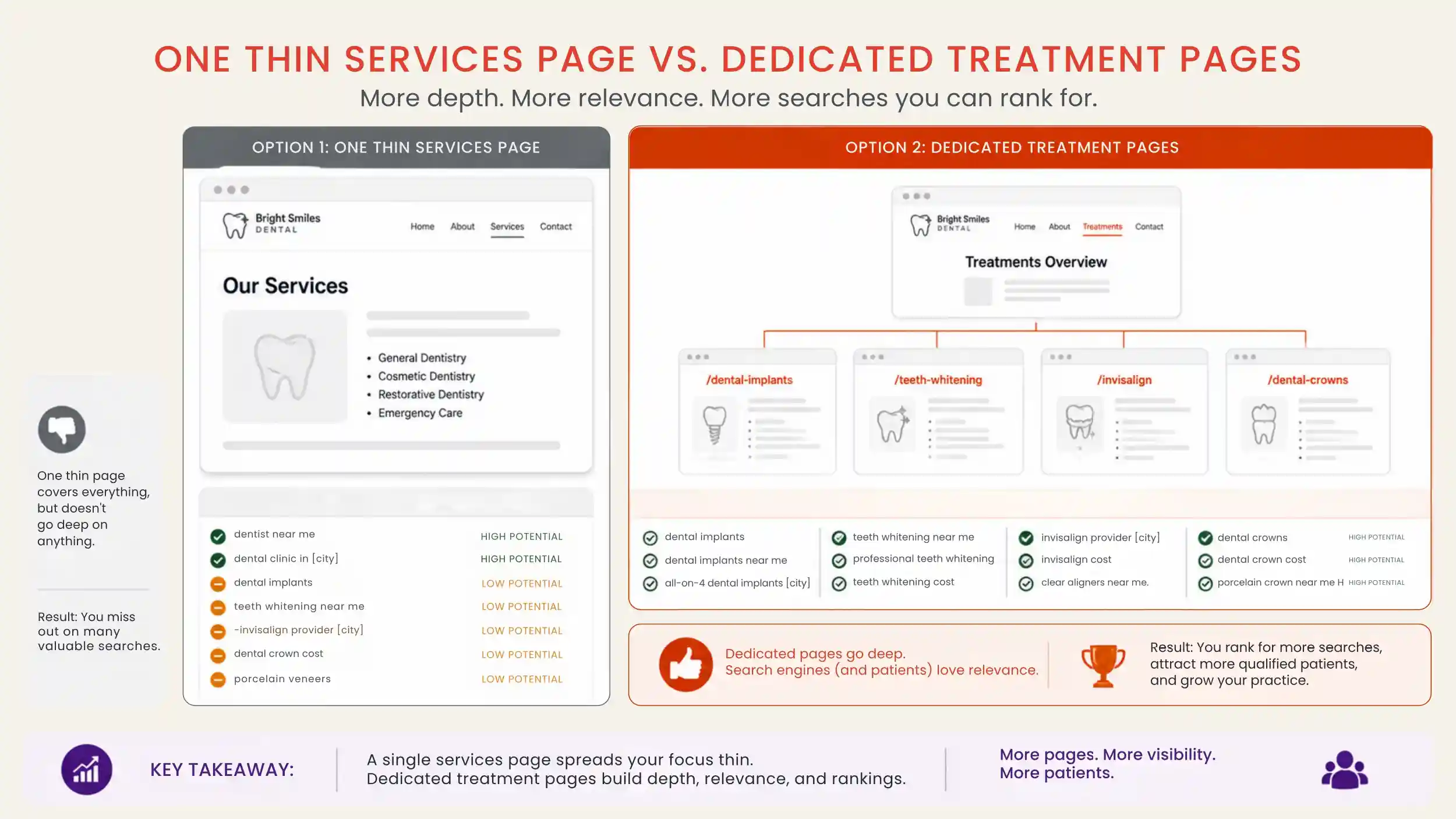
Here is what we see most often when we audit a dental site. The technical work is fine, the profile is claimed, and the practice still stalls because it has one thin services page standing in for eight treatments patients search individually.
What dental SEO is
Dental SEO is the work of making a practice rank in search results for the treatments it provides and the area it serves, covering technical health, on-page content, local signals, and authority. Those four are not equal in a dental context. Local signals and treatment depth carry most of the return, and the other two mostly remove obstacles.
How it differs from general SEO
Dental SEO differs from general SEO in that the buying decision is local, the search happens at the treatment level, and trust signals do work that links normally do. A national content strategy is close to useless to a single-location practice. What matters is being unambiguous about what you treat and where.
What it does not cover
SEO does not cover the phone being answered, the booking form working, or the fees being competitive, and it will happily deliver traffic into all three problems. We treat this boundary as part of the work, because a practice that ranks and does not convert usually blames the wrong thing. Our guide to dental marketing covers where the handoff sits.
Technical foundations
Technical SEO is the part that makes a dental site eligible to rank at all, and it is usually a fixed cost paid once rather than an ongoing programme. Treat it as clearing the floor, not as a growth lever. Once it is done, spending more there returns very little.
Speed, mobile rendering, and crawlability
A dental site has to load quickly on a phone, render its content without JavaScript blocking it, and let search engines reach every treatment page in a couple of clicks. Most practice sites fail on image weight before anything else. Uncompressed clinical photography is the usual culprit.
Site structure for a multi-treatment practice
Structure a practice site so every treatment sits one level below a services parent and every location sits one level below a locations parent, because flat structures and deep burial both cost rankings. The test is whether a patient can reach any treatment in two clicks from the homepage.
Treatment pages and content depth
The single biggest ranking lever for a dental practice is one thorough page per treatment, because that is the level at which patients search and the level at which most practice sites are thinnest. This is where the work is, and it is the part practices most often skip in favour of blogging.
How many pages a treatment needs
Each treatment you want to be found for needs its own page, and combining implants, veneers, and orthodontics onto one services page means competing for none of them properly. Split them even when the clinical work overlaps, because the searches do not.
What a complete treatment page answers
A complete treatment page answers what the procedure is, who it suits, what it costs or what drives the range, what recovery involves, and what happens at the first appointment. Most practice pages answer the first and stop. The rest is what the patient actually came for.
Cost and recovery content patients look for
Cost and recovery are the two things patients search hardest for and the two things practice sites most often omit, usually out of a reasonable worry about quoting fees. A range with the variables named beats silence, because silence sends the patient to a competitor who answered.
Local signals
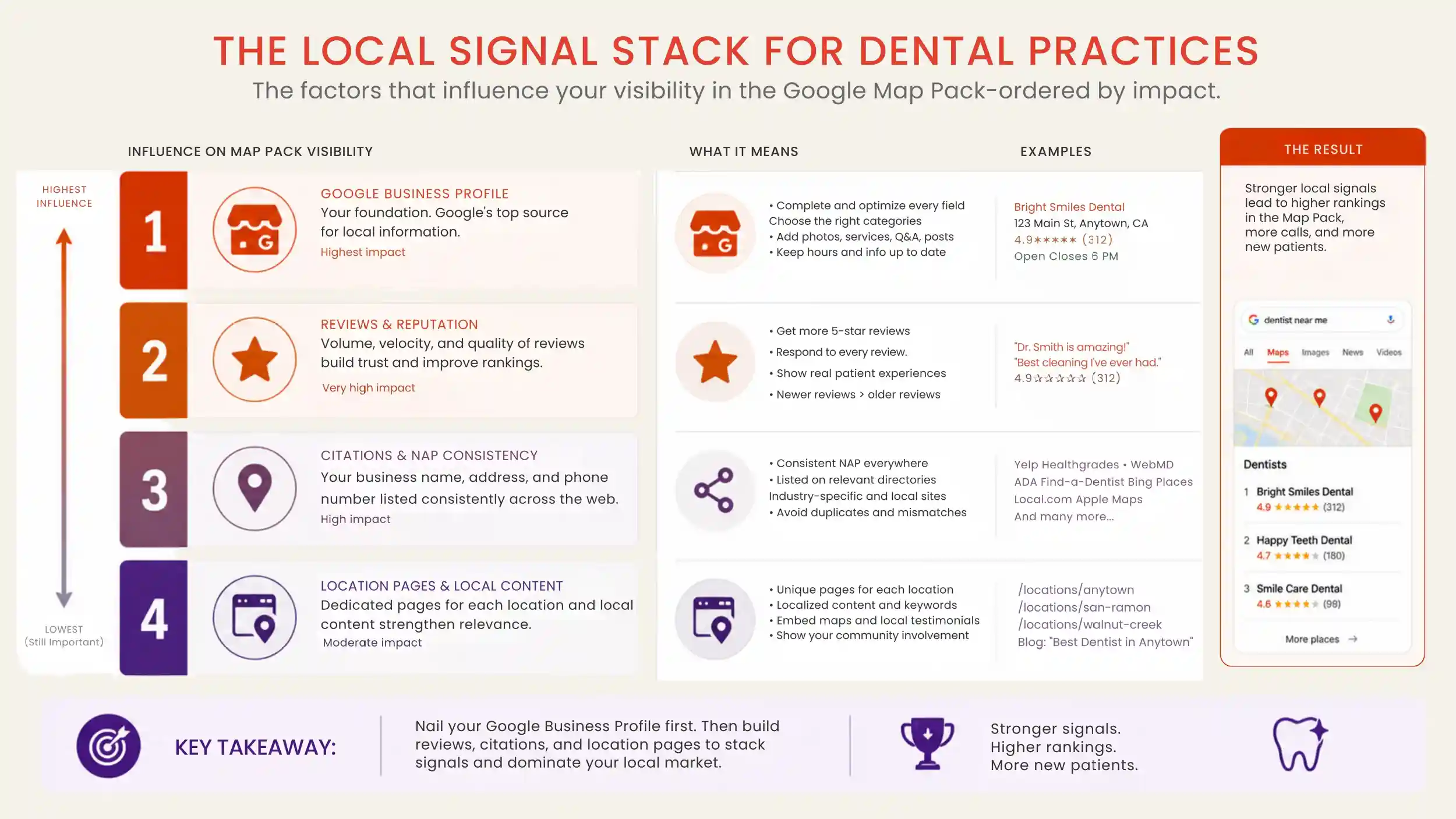
Local signals decide which practices appear in the map pack, and for a practice with a physical chair they outrank almost every other factor in commercial value. This is the highest-return part of dental SEO for most single-location practices, and we cover it in depth in local SEO for dentists.
Profile, categories, and service areas
Your Google Business Profile needs the right primary category, every service you actually provide listed, and a service area that reflects where patients genuinely travel from. Category choice alone can move map visibility more than a month of content work.
Reviews and their effect on ranking
Reviews influence both map ranking and the patient’s choice, and recency carries more weight than a perfect lifetime average. A steady trickle beats a burst, and a burst after a long gap reads as a campaign to both Google and the reader.
Authority and links
Authority in dental SEO comes mostly from local relevance, professional listings, and genuine community presence rather than from volume link building. This is the area where practices most often waste money, because the tactics that work in competitive national niches do not transfer.
Local citations
Local citations are your practice details listed consistently across the directories that matter, and the goal is accuracy on a short list rather than presence on a long one. Dental association listings, insurance directories, and the major aggregators cover almost all of the value.
What to avoid
Avoid bought link packages, private blog networks, and any vendor that will not tell you where a link came from, because in a licensed profession the reputational risk outweighs the ranking upside. If a firm cannot name its sources, that is the answer.
SEO Is My Love Language was founded by Jose Villalobos, who has spent his career on a single discipline: getting businesses found, cited, and recommended by AI search. He has been a member of Koray Tuğberk Gübür’s Holistic SEO Community since 2022, is a graduate of the Topical Authority Course, holds the Google AI Professional Certificate, and is a member of Kyle Roof’s IMG. That combination, topical authority strategy paired with rigorous on-page execution, is what our team brings to every practice we work with.
AI search: the half of the job that is new
Ranking in the blue links is now only half of search visibility, because AI Overviews and assistants answer a growing share of dental questions by citing sources instead of sending clicks. The practices named in those answers are not reliably the ones sitting at position one, which is what makes this a separate job rather than a by-product of ranking well.
How AI answers pick their sources
AI answers are assembled from pages the model can read cleanly and judge trustworthy, which favours plain structure, direct statements, and complete coverage of a question over keyword-tuned copy. Being crawlable and being quotable turn out to be the same engineering problem.
What makes a page quotable
The test for a treatment page is whether any single paragraph can be removed from the page and still make sense to a patient reading it cold. If it can, an assistant can quote it. If it depends on the paragraph before it for its subject, it cannot be lifted and will not be used.
How to measure AI citation
Measuring AI citation means checking whether assistants name your practice for the questions you have answered, which is a different measurement from rank tracking and needs its own process. Nobody should be reporting AI visibility to you off a rankings dashboard, because the dashboard does not see it.
Timelines and what to expect
Dental SEO typically shows movement in three to six months and compounds after twelve, and any timeline shorter than that is a claim about the market rather than about the work. We would rather lose a deal than agree to a ninety-day promise on a competitive metro.
A realistic first year
A realistic first year is technical fixes and profile work in the first quarter, treatment pages through the second and third, and authority and citation work running underneath from the start. Rankings move last, which is why practices abandon programmes at month four.
Early signals that it is working
The earliest signal is impressions rising on treatment terms before positions do, followed by map views, followed by calls. If none of those three has moved by month four, something is wrong with the work rather than with the timeline. If you are weighing whether to run this in house, our guide to dental SEO companies covers how the category splits.
Frequently asked questions
What is SEO in dentistry?
Dental SEO is the work of making a practice’s website and profiles rank in search results for the treatments it provides and the area it serves. It covers technical health, on-page content, local signals, and the authority that earns rankings.
How much does dental SEO cost?
Dental SEO typically runs from a few hundred dollars a month for a single location to several thousand for competitive metros or multi-location groups. The variable is not the practice, it is how contested the local market is and how much content the site is missing.
How to do SEO for dental clinic?
Start with a technically sound site and a complete Google Business Profile, then build one page per treatment you want to be found for, then earn reviews and local citations. Publishing depth on treatments is what separates practices that rank from practices that stall.
What are SEO practices?
The core practices are keyword and intent research, technical fixes, on-page optimisation, content that fully answers the query, internal linking, and authority building. For dentistry, local signals and treatment-level depth matter more than anything else on that list.
Is SEO dead or evolving in 2026?
SEO is not dead, it has split in two. Ranking in the blue links is now only half the job, because AI Overviews and assistants answer a growing share of searches by citing sources rather than sending clicks, and being the cited source is the other half.
Get Your Practice Found by AI Search
Over the next few years the practices that take their markets will be the ones an assistant names first when a patient asks who to see. That is a different job from ranking, and the vendors selling dental marketing have not won it yet: all 31 pages we found them publishing on AI search, across four of the five vendors crawled and checked July 2026, carry zero ranking keywords, which we set out in full on our dental marketing page. See where your practice stands in AI answers today and what it would take to own the answer. Book a strategy call and we will show you.