Dental SEO Companies: How the Category Splits and How to Compare It
Dental SEO companies do not have a single best, and asking which one is best is the question that leads practices into the wrong contract. Whichever you hire, the thing being bought is your practice found and named when a patient searches, and firms get there by very different routes. The category contains four quite different kinds of business selling under one label, and the useful question is which type fits the gap your practice actually has. This page maps the types, states what a retainer normally includes, and gives you the questions that separate a serious firm from a confident one.
We write this as a firm that competes in this category, so read it accordingly. What follows is the comparison we would want a practice to run on us.
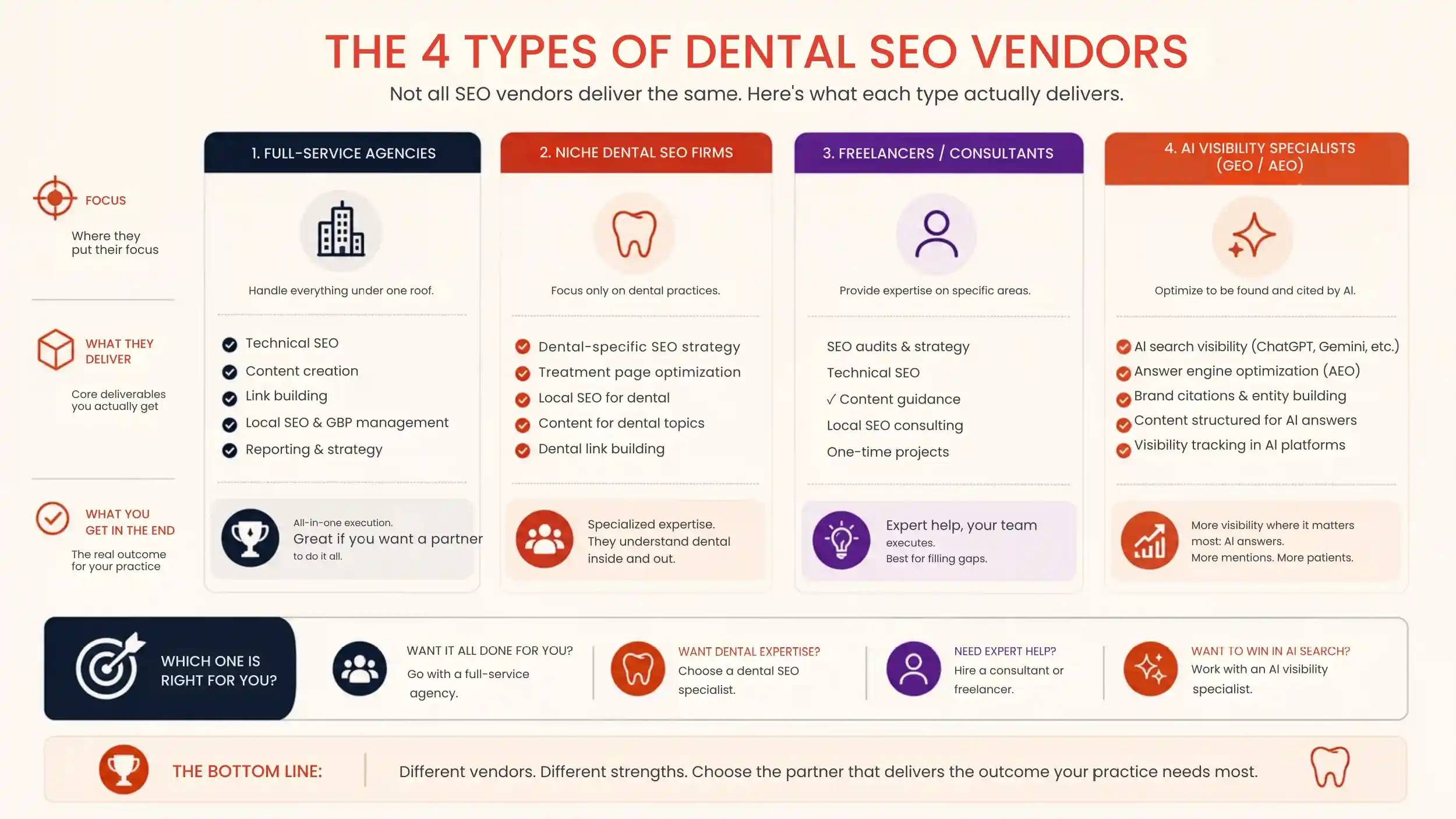
What a dental SEO company actually delivers
A dental SEO company audits the site, researches terms, fixes technical problems, builds content, optimises local profiles, and reports, though the specific bundle varies enough that the same label covers very different work. Two proposals at the same price can differ by a factor of three in what arrives each month. Comparing the bundles is the whole exercise.
The deliverables that appear in most contracts
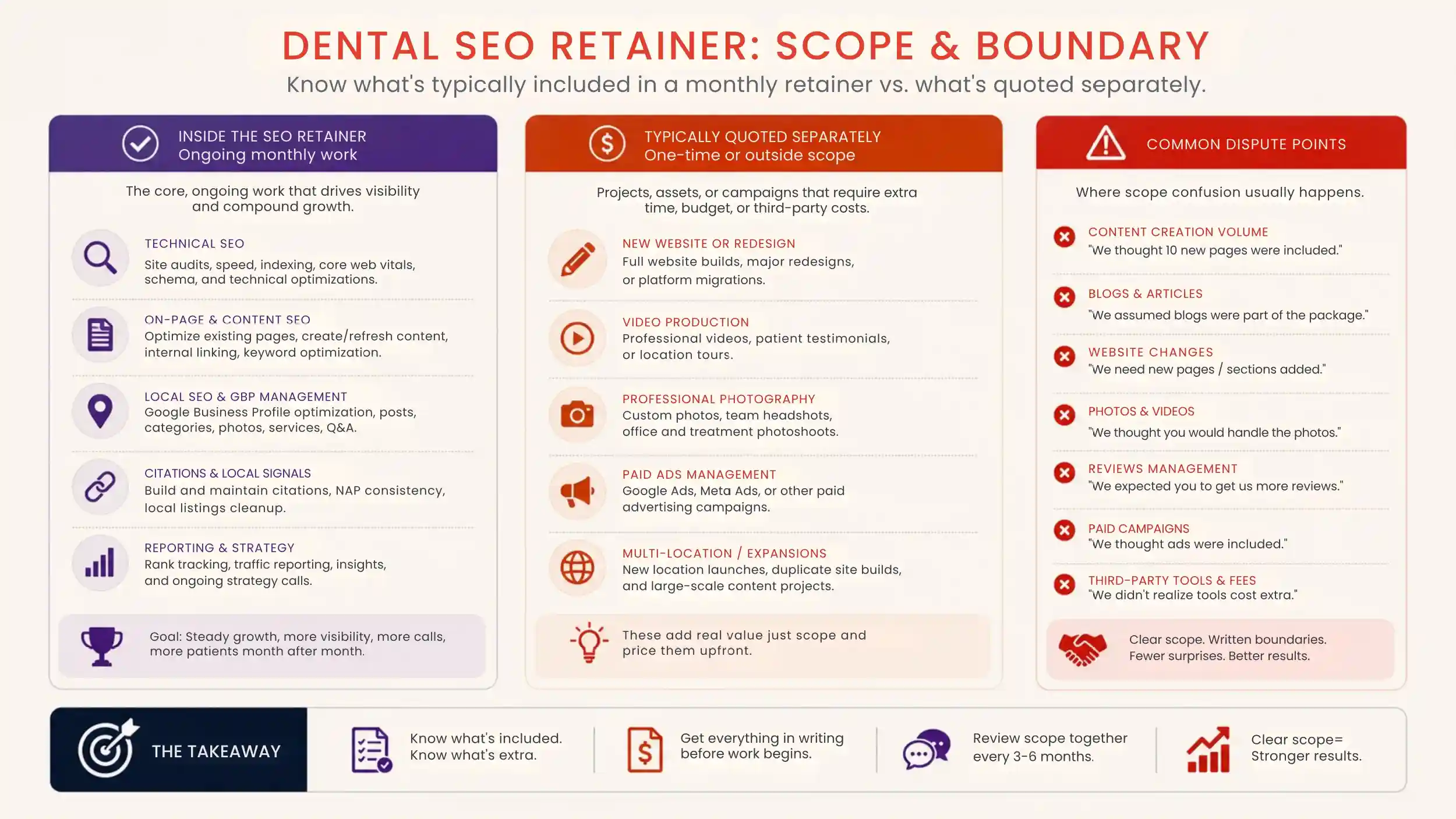
Most contracts include a technical audit, keyword research, on-page optimisation of existing pages, Google Business Profile management, and a monthly report. Those five are close to universal and are not a differentiator. If a proposal stops there, you are buying maintenance.
The deliverables that usually cost extra
New treatment pages, content writing, link acquisition, review generation, and anything touching the website build usually sit outside the base retainer and are quoted separately. Since treatment page depth is the largest ranking lever in dentistry, a retainer that excludes content is missing the part that moves rankings.
The types of firm in this category
Dental SEO firms fall into four recognisable types, and the differences between them matter more than any ranking of individual companies. Each type is genuinely good at something and genuinely weak somewhere else.
Full-service dental marketing agencies
Full-service dental agencies handle advertising, website, social, and SEO together, which suits a practice that wants one supplier and one invoice. The trade-off is that SEO is one line in a broad offer, and depth on it varies. Ask what proportion of the retainer is organic work.
Website platform vendors with SEO attached
Platform vendors sell a dental website on their own system with SEO bundled in, which is convenient and cheap to start. The risk is that the arrangement is only cheap while it lasts, because a site built on a vendor’s platform does not travel and the cost of leaving is a rebuild. Ask what you take with you before you sign, not after.
Paid-media specialists who also sell organic
Paid-media firms are strong on advertising and often sell organic as an add-on, which can mean a junior running a checklist against a channel the firm does not specialise in. The tell is whether their case studies show organic growth or ad performance. Our guide to dental advertising covers where these firms genuinely excel.
Search visibility specialists
Visibility specialists do organic search only, including the AI citation side, which suits a practice whose advertising is already working and whose organic presence is not. Paid media stays somebody else’s job, which suits a practice whose ads already work. This is the category we sit in, and we would not recommend it to a practice whose phone is the actual problem.
Single practices and groups buy differently
A single practice is buying attention on one location while a group is buying a system that works the same way across many, and a firm good at one is not automatically good at the other. The single-site question is whether the work gets done at all, because a small retainer spread across a large agency tends to become a checklist run by whoever is free. The multi-site question is the opposite: whether the firm can hold consistency across locations that share a brand but compete in different markets, each with its own profile, its own reviews, and often its own set of local rivals.
The failure mode for a group is a firm that treats seven locations as one client and publishes the same page seven times with the town name swapped. That is not local SEO, it is duplication, and it tends to leave the whole group competing with itself. Ask a firm with group experience how it handles two of your locations that draw from an overlapping area, because that is the question that has no template answer and the answer will tell you whether they have done it before.
What dental SEO costs
Dental SEO retainers commonly sit between roughly seven hundred and five thousand dollars a month, driven by market competitiveness and deliverable volume rather than by the size of the practice. A single-chair practice in a contested metro can cost more to compete for than a group practice in a quiet one.
What sits inside a retainer and what does not
A retainer normally covers the recurring work, while one-off items such as a site rebuild, a content backlog, or a migration are quoted separately. Get the boundary written down. Most disputes we see are about scope rather than price.
Contract length and exit terms
Twelve-month terms are normal because the work takes that long to compound, but a twelve-month term with no exit clause and no ownership transfer is a different proposition entirely. Ask what happens to the site, the content, and the analytics if you leave in month seven.
What you keep if you leave
You should leave with the domain, the website files and database, every page and image written for you, the Google Business Profile, and admin access to your own analytics and Search Console, and a firm that hesitates on any one of those is telling you something. This page has twice told you to press hardest on the exit question, so here is what a good answer sounds like rather than only the instruction to ask it.
A good answer is specific and unbothered. The firm says the domain is registered to your practice and always was, the site can be exported or handed over as files, the content is yours because you paid for it, and the profiles are owned by your Google account with the firm added as a manager. A poor answer is vague, or it agrees in principle while the practical arrangement says otherwise: the domain sits in the agency’s registrar account, the site runs on a platform you cannot export, the analytics property belongs to the agency, or the Business Profile is owned by an agency address and you are merely a manager on it.
The distinction that matters is ownership against access. Being a manager on a profile you do not own means the owner can remove you. Check the registrar record and the profile ownership yourself before you sign, because both are visible without asking anybody, and neither is a matter of opinion.
SEO Is My Love Language was founded by Jose Villalobos, who has spent his career on a single discipline: getting businesses found, cited, and recommended by AI search. He has been a member of Koray Tuğberk Gübür’s Holistic SEO Community since 2022, is a graduate of the Topical Authority Course, holds the Google AI Professional Certificate, and is a member of Kyle Roof’s IMG. That combination, topical authority strategy paired with rigorous on-page execution, is what our team brings to every practice we work with.
How to compare firms honestly
Compare firms on evidence rather than confidence: dated dental case studies, a written monthly deliverable list, clear ownership of the site and content, and reporting that goes past ranking screenshots. Every one of those is a document, not an opinion, which is what makes them comparable.
Questions that separate the serious from the rest
Ask who specifically will do the work, what shipped for a comparable practice last quarter, what happens if results stall at month six, and what you own on exit. The answers separate firms faster than any portfolio. The exit answer is the one to press hardest, because it is the only one that gets more expensive the longer it goes unasked.
Claims that should end the conversation
Guaranteed rankings, a promised position by a fixed date, and any refusal to name where links come from should end the conversation, because none of them is deliverable honestly. Google does not sell rankings, so nobody can guarantee them.
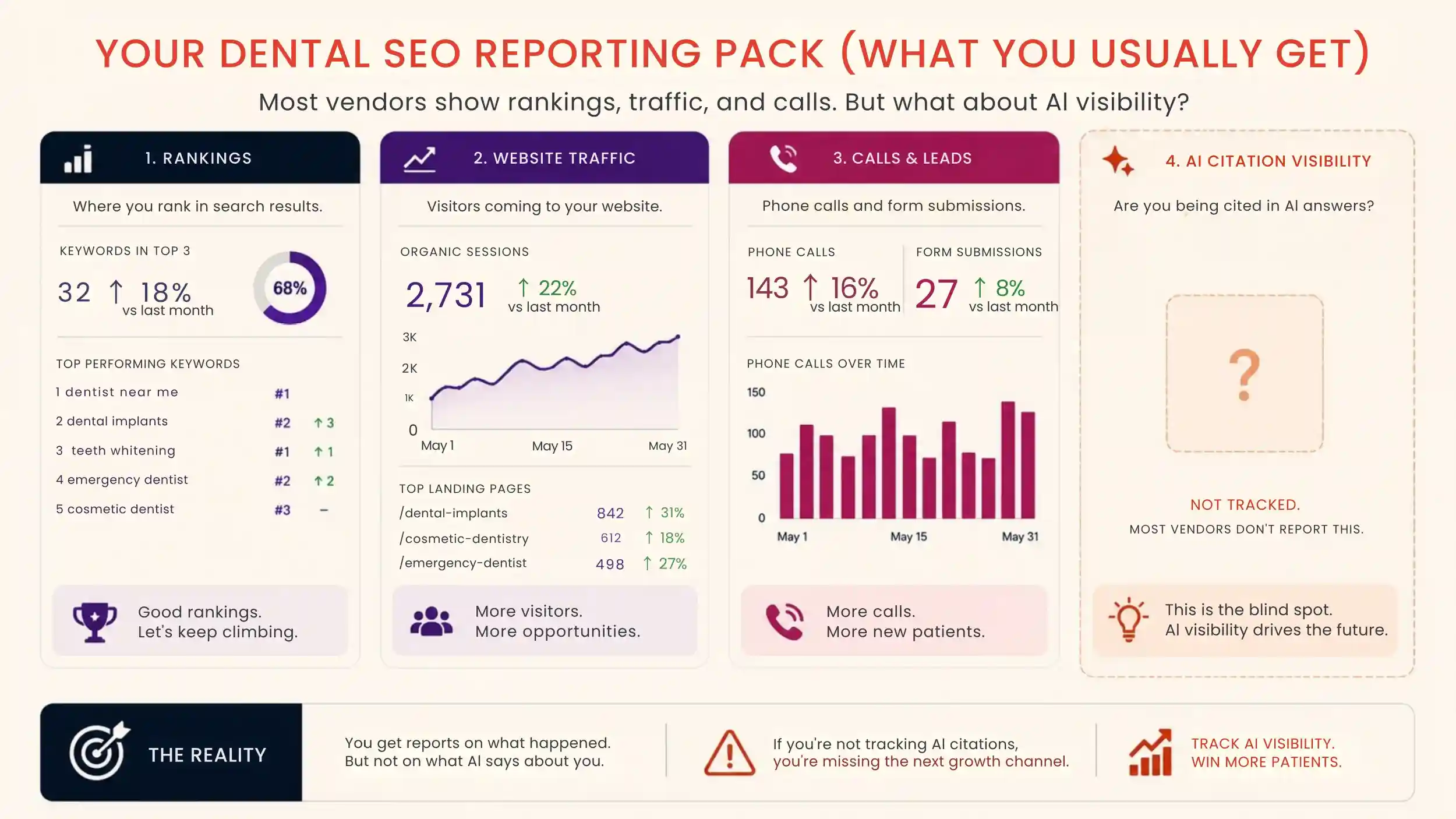
What a good monthly report contains
A good monthly report tells you what was done, what moved, and what happens next, in that order, and it is legible to somebody who does not work in search. This page keeps saying reporting should go past ranking screenshots, so it is worth stating what going past them actually means.
What was done is a list of the work that shipped, named specifically: these three pages published, this technical fix applied, these profiles updated, these reviews requested. It should match the deliverable list in your contract closely enough that you can tick items off. What moved is the outcome side, and the useful figures are calls, form submissions and booked appointments from organic search, not sessions. Traffic is an input you cannot bank. A report that leads with sessions and never reaches enquiries is measuring the firm’s activity rather than your return.
The part most reports omit is the third one. What happens next means the plan for the coming month and, more usefully, what the firm expects to be true in three months if the plan works. That last sentence is the one that makes a report accountable, because it can be checked later. Ask to see a real report from an existing client with the name removed before you sign. A firm confident in its reporting will show you one, and the sample tells you more than any proposal does.
What to ask about the first ninety days
Ask what specifically will exist ninety days from signing that does not exist now, because the answer separates firms that have a plan from firms that have a process. The first ninety days are where most dental SEO relationships quietly go wrong, and they go wrong in a predictable way: the audit arrives, the technical fixes get made, the reporting starts, and then very little is published.
A reasonable ninety-day answer names artefacts rather than activities. Something like a technical audit delivered in the first fortnight and the fixes applied by week six, the Business Profile fully populated, a page written for each of your highest-value treatments, and the first report showing enquiries rather than positions. Rankings will mostly not have moved yet and an honest firm says so, because in dentistry the compounding starts after the content exists, not after the audit does.
The warning sign is an answer made entirely of verbs. Optimising, researching, monitoring and strategising are things a firm can do for ninety days while producing nothing you can point at. If you cannot picture what will be sitting on your website at the end of it, neither can they.
The gap almost nobody covers yet
Whether an assistant names your practice is measurable, and a report that covers it looks different from one that does not: it names the prompts checked, the date checked, and what changed since the last check. Ask for that specifically, because a report built on rankings alone will not contain it. We think this becomes a standard reporting line within two years, and practices signing multi-year contracts now should ask for it before it does.
Why citation and ranking are different problems
Ranking is about position in a list, while citation is about being the source an answer is built from, and a page can do one without the other. Rank tracking cannot see citation, so a firm reporting only rankings is not reporting on this at all.
What to ask a vendor about AI search
Put it as a process question rather than a capability question: what gets checked, how often, and what changes when the check comes back empty. Capability questions invite a yes.
The empty result is the part worth pressing on, because early on it is the likely one and it is where a firm either has a method or does not. A vendor with a method treats an empty check as a diagnosis: the assistant named competitors, so what do their pages answer that yours do not, and which of those gaps is worth closing this month. A vendor without one treats it as a reason to keep waiting. Ask what they did the last time a check came back empty for a client, and listen for whether anything followed from it.
In house or outsourced
Running dental SEO in house works when one person owns it every week, and it stalls at the point where treatment content has to be published consistently. That is the honest dividing line, and it has nothing to do with technical skill.
What a practice can realistically do itself
A practice can realistically own its Google Business Profile, its review process, and its photography without outside help, and those three carry a large share of local visibility. What tends not to survive contact with a full schedule is writing a thorough treatment page every month. Start with the three you can hold, then decide about the fourth. Our guide to dental marketing maps where each of those sits.
Comparing two proposals honestly means comparing what each names, and the document that has to name it is covered in the four things a scope must specify to be enforceable.
Frequently asked questions
What does an SEO company do?
An SEO company for a dental practice does five things: fixes what is technically broken, works out which treatment searches are worth winning locally, writes the treatment and location pages that compete for them, manages the profile and reviews that decide the map pack, and reports on what moved. The label covers all five at one firm and one of them at another.
How to choose a dental SEO company?
Choose on evidence rather than confidence: ask for dental case studies with dates, ask exactly what is delivered each month, ask who owns the site and the content if you leave, and ask how they measure results beyond rankings.
How much does an SEO agency typically cost?
Dental SEO retainers commonly sit between roughly seven hundred and five thousand dollars a month, with the spread driven by market competitiveness and deliverable volume rather than by practice size.
What is SEO in dentistry?
Read as a purchase rather than a discipline, dental SEO is whatever appears on the deliverable list you are being asked to sign. Two firms using the word identically can be selling a monthly report and a full content programme, so the comparison has to be made on the list rather than on the label.
How to do SEO for dental clinic?
You can run dental SEO in house if someone owns it weekly, or hire it out. The decision usually turns on whether anyone on staff has time to publish treatment content consistently, since that is the part that stalls first.
Get Your Practice Found by AI Search
If you have two proposals in front of you, put the same question to both: what would you check, and how often, to know whether an assistant is naming this practice. You will learn more from how quickly they can answer than from what the answer contains. See where your practice stands in AI answers today and what it would take to own the answer. Book a strategy call and we will show you.