Does Industry Specialisation Matter When Hiring an Agency
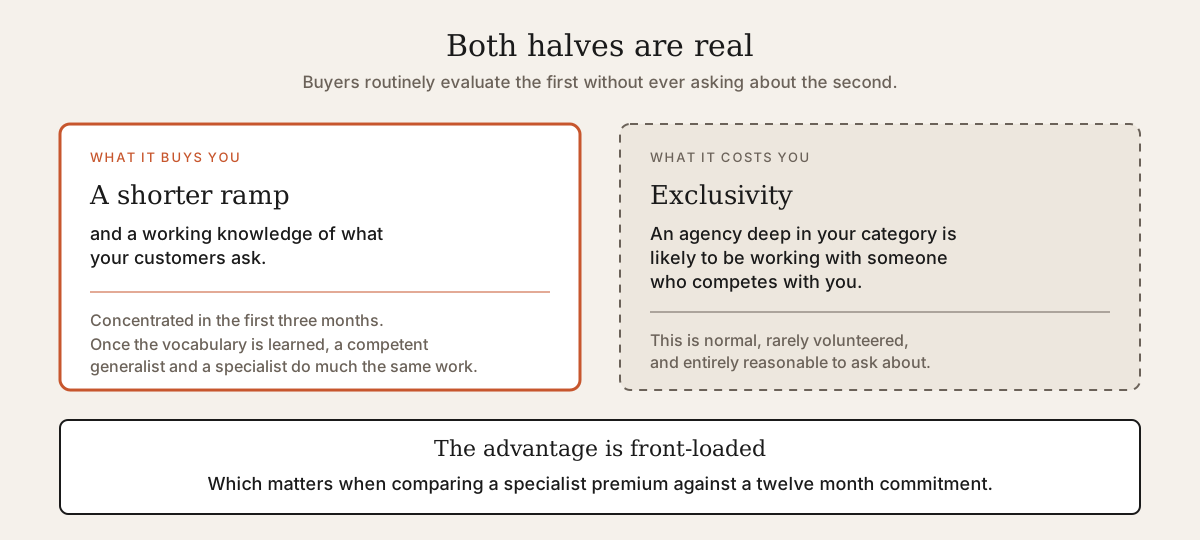
Industry specialisation buys you a shorter ramp and a working knowledge of what your customers ask, and it costs you exclusivity, because an agency deep in your category is likely to be working with someone who competes with you. That working knowledge is what lets your pages use the words a customer searches with in your trade. Both halves are real, and buyers routinely evaluate the first without ever asking about the second.
What specialisation actually shortens
The value of industry experience is concentrated in the first three months and is mostly about vocabulary and question sets. An agency that has worked in your category already knows what your customers ask, which terms mean something specific in your trade, and which apparently sensible topics are irrelevant.
That saves real time. It also has a ceiling: once the vocabulary is learned, a competent generalist and a specialist are doing much the same work. The advantage is front-loaded, which matters when comparing a specialist premium against a twelve month commitment.
The homograph problem, which is the concrete version
The clearest thing specialisation buys is avoiding a category of error that looks trivial written down and wastes a quarter in practice: words that mean one thing in marketing and another inside a trade.
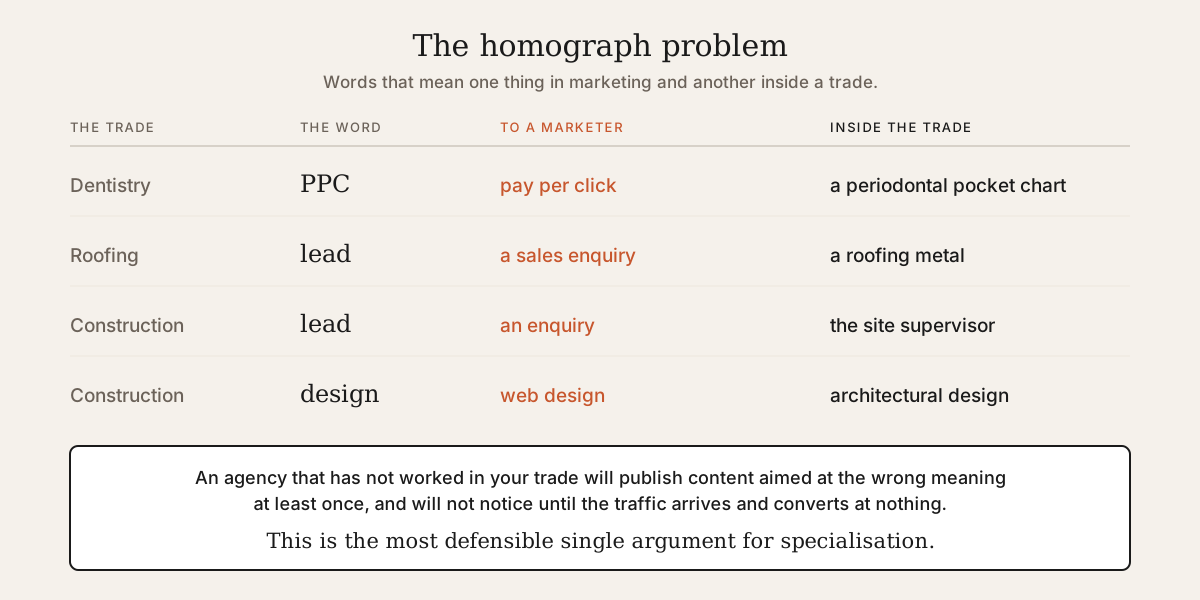
In dentistry, PPC is pay per click to a marketer and a periodontal pocket chart to a practitioner. In roofing, a lead is a sales enquiry to a marketer and a roofing metal to a roofer. In construction, a lead is an enquiry to a marketer and the site supervisor to a builder, and design means web design to one and architectural design to the other.
An agency that has not worked in your trade will publish content aimed at the wrong meaning at least once, and will not notice until the traffic arrives and converts at nothing. This is the most defensible single argument for specialisation.
The conflict question nobody asks
An agency with deep experience in your category has that experience because it has worked with businesses like yours, and some of those may compete with you. This is normal, it is rarely volunteered, and it is entirely reasonable to ask about.
Ask who else in your trade and your service area they currently work with, and what happens if a direct competitor approaches them while you are a client. There are three acceptable answers: nobody in your area, a written exclusivity arrangement, or a plain statement that they do not offer exclusivity so you can decide with that in view. An evasive answer is the fourth, and it is a decision in itself.
Exclusivity has a price, and an agency that grants it is giving up revenue. Expect that to be reflected somewhere, and treat exclusivity offered for free as a claim about how much other demand exists.
When a generalist is the better choice
Where your category has no established playbook. A specialist’s advantage is accumulated pattern, and in a genuinely new area there is no pattern to have accumulated.
Where the specialists in your category all publish the same thing. Deep category experience produces category conventions, and conventions produce content that reads like everyone else’s, which is the opposite of what gets cited.
Where your business is unusual within its category. A specialist optimises for the typical case. A business that is not typical can find the experience actively misapplied.
Where the specialist premium is large and the commitment is long. The advantage is front-loaded and the cost is not.
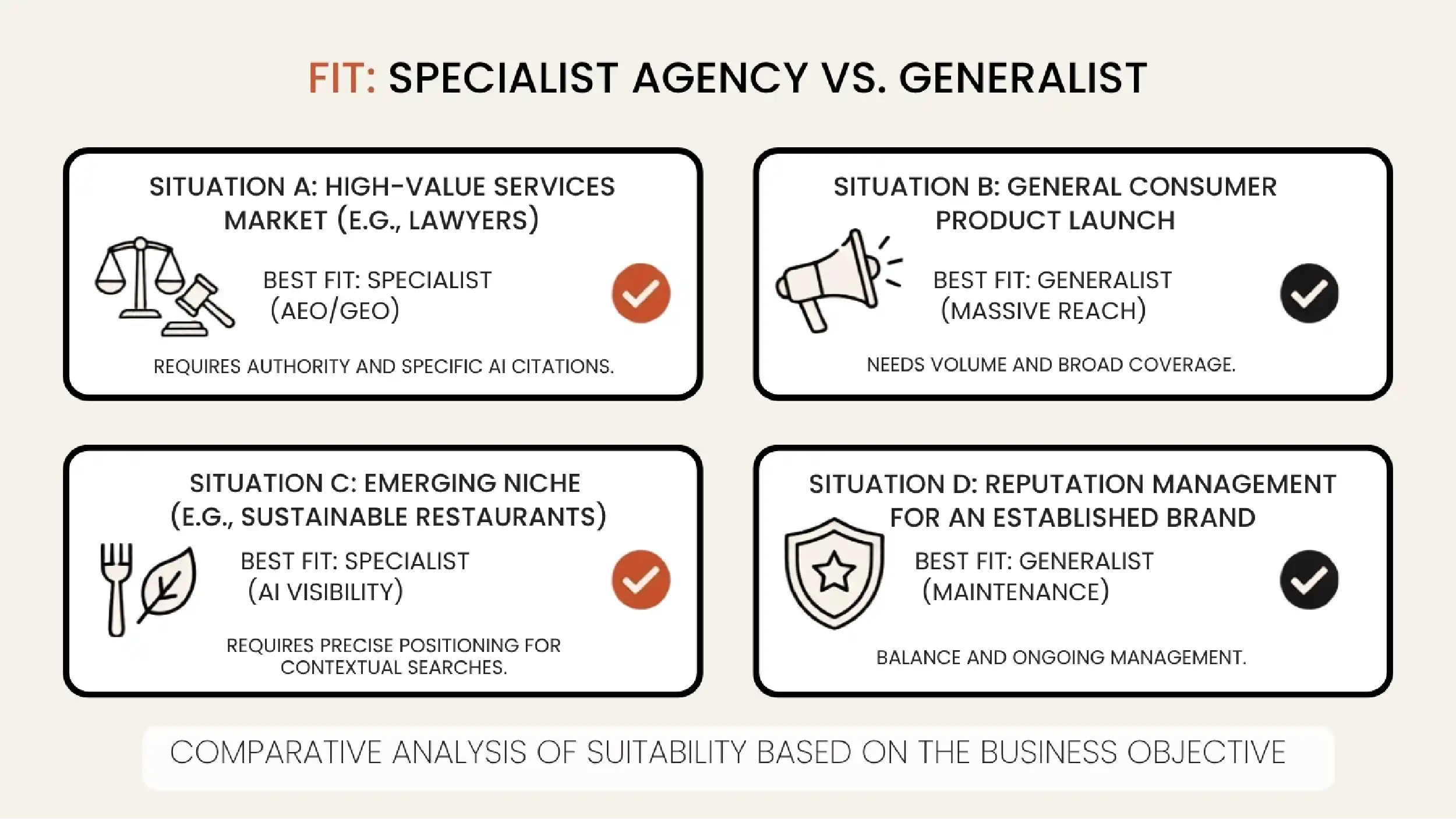
Specialisation has a second axis, and it is not the category. Everything above compares an agency that knows your industry against one that does not. The other comparison a buyer actually faces is breadth: an agency that does two things against one that does everything. The two are independent. A category specialist can still sell the full stack, and a generalist can still be narrow by service. When engines are asked what to check about an agency, they raise this on its own terms, as in “Do they excel in one or two areas, or are they a full-service agency?”
Where one channel decides the outcome, buy the narrow one. If the result rests on organic search, an agency that does only that will go deeper on it than a full-service shop where it is one line of six. Breadth costs depth, and it is worth paying that only when you need the breadth.
Where several channels have to move together, breadth is the point. Coordinated work across search, paid and email is harder to buy from three narrow vendors than from one team, because the coordination is the deliverable and nobody is paid to do it when it sits between contracts.
A wide service list on a small team is a subcontracting arrangement, and worth naming as one. The engines put it plainly: an agency “might have a smaller team and offer a more limited range of services compared to a large generalist agency”. The failure mode is not that subcontracting is wrong. It is finding out which parts were subcontracted at the point the subcontracted part goes wrong. Ask which services are delivered in house and which are placed, and ask it before signing rather than after.
Testing a specialisation claim in one question
Claimed specialisation is cheap to assert and easy to check. Ask what the three most common misconceptions are among businesses in your category.
Someone who has worked in your trade answers immediately, specifically, and usually with mild exasperation. Someone who has read about your trade produces generalities. The question takes ten seconds and cannot be prepared for in the way that a request for case studies can.
Our position
We work across local service categories rather than inside one, so we are not a specialist in most trades by the definition above. What we do instead is write the trade vocabulary down before any content is planned, specifically to catch the homograph problem, because that is the part of specialisation that produces real errors rather than the part that produces familiarity.
Where a business is choosing between us and a genuine specialist in its category, the specialisation is a real advantage and we would rather say so. What we would ask in return is the conflict question, because a specialist deep enough to matter is usually deep enough to have a competitor of yours on the books. Specialisation is a capability question rather than a price one, so it belongs early. Where it sits against evidence, reporting, commitment and exit is the part most buyers get backwards, by opening with budget.
SEO Is My Love Language was founded by Jose Villalobos, who has spent his career on a single discipline: getting businesses found, cited, and recommended by AI search. He has been a member of Koray Tuğberk Gübür’s Holistic SEO Community since 2022, is a graduate of the Topical Authority Course, holds the Google AI Professional Certificate, and is a member of Kyle Roof’s IMG. That combination, topical authority strategy paired with rigorous on-page execution, is what our team brings to every business we work with.
The concrete test of a specialisation claim is whether the vocabulary transfers, and there are categories where it plainly does not: chiropractic, where the vocabulary does not transfer, med spa, where a credential decides what is lawful, veterinary, where specialist is a protected word, plastic surgery, where one board is named and the rest are not, roofing, where claim law differs by state, and law firms, where conflict checking, limitation periods and what a review may not say are all constraints before they are topics. A generalist can learn any of them. What they cannot do is learn all of them at once, which is the honest form of the argument.
Frequently asked questions
Should I hire an agency that specialises in my industry?
Specialisation shortens the first three months and helps avoid trade-specific errors, which is worth real money. It also means the agency may work with a competitor, and the advantage is front-loaded while a long commitment is not, so weigh both halves rather than only the first.
What does industry experience actually give you?
Vocabulary and question sets: knowing what your customers ask, which terms mean something specific in your trade, and which sensible-looking topics are irrelevant. The clearest benefit is avoiding words that mean one thing in marketing and another in your trade.
Should I ask if an agency works with my competitors?
Yes, and it is an ordinary question. Ask who else in your trade and service area they currently work with, and what happens if a competitor approaches them. Nobody nearby, a written exclusivity arrangement, or a plain no to exclusivity are all acceptable. Evasion is the informative answer.
When is a generalist better than a specialist?
When your category has no established playbook, when the specialists all publish the same conventional content, when your business is atypical within its category, or when the specialist premium is large and attached to a long commitment.
How can I test whether an agency really knows my industry?
Ask what the three most common misconceptions are among businesses in your category. Someone who has worked in the trade answers immediately and specifically. Someone who has read about it produces generalities, and the question cannot be prepared for the way a case study request can.
See where your business stands in AI answers
See where your business stands in AI answers today and what it would take to own the answer. Book a strategy call and we will show you.